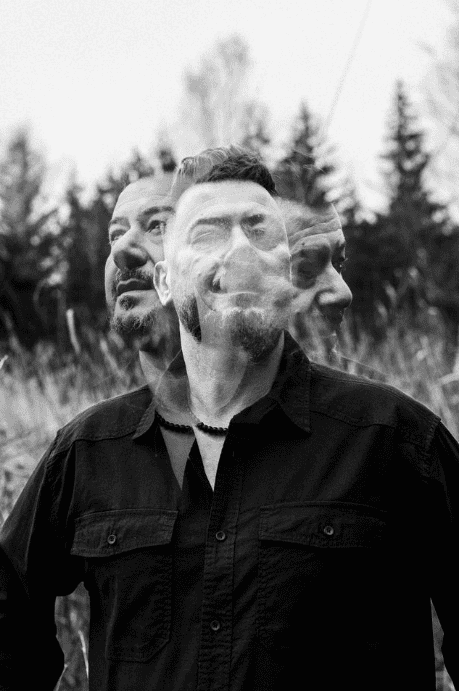
Black Reuss will release their new album “Death” on February 27, 2026! On this occasion, Metalwar.gr got in touch with the band to learn all the details.
Metalwar: Death completes the four-part river-of-life concept. Did you always plan this ending from the beginning, or did the story evolve naturally over time?
Black Reuss: The ending was planned from the beginning. The tetralogy was conceived as a complete cycle early on, with Metamorphosis, Journey, Arrival, and Death each representing a defined state within the same flow. Even the visual language and the artwork for all four albums were created together as part of that concept. What evolved over time was not the structure, but the depth that came from living through each chapter.
Metalwar: What does the concept of “death” symbolize in the Black Reuss universe and on a personal level for you?
Black Reuss: With Death, the approach was fundamentally different from the previous chapters. On Metamorphosis, Journey, and Arrival, I could rely much more on my own experiences and inner processes. Death itself is different — it’s something I don’t truly know. Because of that, I didn’t want to present a single interpretation.
Instead, the album explores death through multiple perspectives, each reflected in different songs. One song approaches death as a form of purgatory — a suspended state where nothing is resolved and time seems to stand still. Another song explores death as oblivion, where identity, memory, and meaning dissolve. Other tracks suggest death as continuation or transformation, while toward the end of the album it is approached as rest or peace — something close to the idea of nirvana, not as reward, but as release.
Personally, this felt like the only honest way to deal with the subject. Rather than pretending to understand death, I wanted to acknowledge its uncertainty. The lyrics don’t give answers — they show how differently death can be perceived, depending on belief, fear, or acceptance.
Metalwar: How does Death differ emotionally and musically from Metamorphosis, Journey, and Arrival?
Black Reuss: Emotionally, Death is calmer and more restrained. The earlier albums dealt more with movement, struggle, and confrontation. Death steps away from that and focuses on presence and stillness. Musically, it relies more on atmosphere, repetition, and texture. The heaviness is less about aggression and more about weight and density. It feels more grounded and deliberate.
Metalwar: The album blends heaviness with deep introspection. How did you approach shaping this atmospheric and gothic sound?
Black Reuss: I focused on creating weight through space rather than complexity. Atmosphere was more important than technical display. Long notes, decay, repetition, and restraint allowed the music to breathe and carry emotion naturally. The gothic element comes from mood and patience — letting darkness exist without forcing it.
Metalwar: You wrote, performed, and produced the entire album yourself. How important is complete artistic control for Black Reuss?
Black Reuss: Complete control is essential for Black Reuss. The project is built around inner states and atmosphere, and those things don’t translate well through compromise. Working alone allows ideas to stay honest from the first note to the final mix. The downside is responsibility, but that solitude is part of the sound.
Metalwar: How did the collaboration with Coroner drummer Diego Rapacchietti influence the final sound of the album?
Black Reuss: With Death, the drums had a very specific role. Because the album deals with different interpretations of death — suspension, inevitability, dissolution, continuation — the rhythm could not be expressive in a traditional sense. It needed to feel grounded, controlled, and inevitable.
Diego brought exactly that. His playing isn’t about showing presence through complexity, but through precision and restraint. He understands how to let space exist and how to give weight to silence. That was essential, because the drums needed to support atmosphere and pacing rather than drive emotion forward. His contribution gave the album a physical backbone without interfering with its conceptual flow.
Metalwar: Tracks like “Oblivion,” “Endgame,” “Phoenix,” and “Elysium” focus on transformation. Is rebirth a central message of the album?
Black Reuss: Rebirth is one possible interpretation, but it’s not the central message. The album doesn’t push a single conclusion. Transformation appears in different forms — erasure, release, continuation, peace. Rebirth exists as one state among many, without promise or celebration. It’s part of the flow, not the destination.
Metalwar: Which song best represents the emotional core of Death and why?
Black Reuss: Oblivion. It carries the essence of the album’s mood and philosophy. It’s uncompromising, restrained, and emotionally neutral. It doesn’t offer comfort or explanation, and that honesty reflects Death as a whole.
Metalwar: Now that this four-album conceptual cycle is complete, do you see this as closure or as the beginning of a new creative chapter?
Black Reuss: It’s closure for the concept, not for Black Reuss. Finishing the tetralogy feels like clearing space rather than ending something. New music is already in progress, without the structure of a multi-album narrative. That freedom opens new possibilities.
Metalwar: What do you hope listeners will feel or discover when they experience Death from start to finish?
Black Reuss: I hope they slow down. I don’t want to guide them toward a specific emotion or message. If the album creates stillness, reflection, or a sense of presence, then it has done its job. Death is not meant to answer questions — it’s meant to allow them to exist.