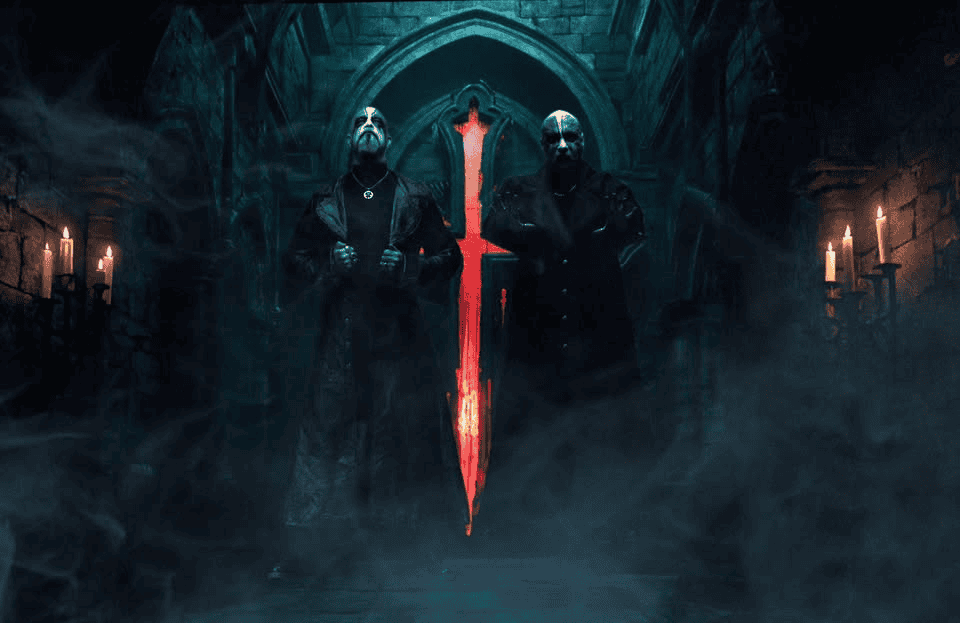
“In the ritualistic depths of German black/death metal, Mystic Circle has always occupied a throne of thorns. Following their infernal resurrection, Beelzebub and A. Blackwar return with ‘Hexenbrand 1486’, a cinematic exploration of medieval terror and inquisitorial shadows.
Today, at Soundstoriesbyjo, metalwar.gr, we have the distinct honor of hosting a profound conversation with the masters of the dark arts. From the crypts of Speyer to the myths of Acheron, the Circle expands once more, revealing exclusive news about the legendary ‘Drachenblut II’ and the future of their satanic journey.”
Jo: Beelzebub & A. Blackwar, hello again! Hexenbrand 1486 dives into the terrifying history of the witch hunts. What specifically drew you to the year 1486 and the dark legacy of Heinrich Kramer? And how did you translate this medieval terror into your sound for 2026?
A. BLACKWAR: Mystic Circle has always dealt with dark themes, legends, and history from our own region. The album Drachenblut takes place in our area, and unfortunately the “Hexenhammer – Malleus Maleficarum” was written here in Speyer by Heinrich Kramer. Before entering the studio, we visited the cathedral in Speyer and went down into the crypt. There was a cold, gloomy atmosphere, and we were able to mentally travel back to that era — a time full of fear and torment. We incorporated that feeling musically into the album.
Jo: Beelzebub, you’ve been steering the ship of Mystic Circle for decades. How do you feel your personal creative vision has evolved from the cult days of the early ’90s to the complex, ritualistic atmosphere of this new chapter?
BEELZEBUB: Since the reunion in 2020 with both founding members back together, the old spirit has returned. Blackwar and I create a unique style of dark art, and we’re highly inspired with new projects. We always say that in the early days we were satanic rebels — and with age, we’ve become deeply inspired by the dark satanic side.
Jo: A. Blackwar, the album achieves a perfect balance between raw black metal and synth soundscapes inspired by ’80s horror films. Was it a challenge to integrate these cinematic layers without losing the band’s traditional ferocity?
A. BLACKWAR: We see it like a painter creating a picture. During pre-production in my studio, we first record all tracks — drums, bass, guitars, and vocals — completely without effects. That way we immediately recognize whether a song has potential and stands strong on its own.
Since we’re huge fans of ’80s films and have a close connection to soundtracks, it actually makes things easier for us. Often a year passes before we enter the studio with the material. Whenever something in a film inspires us, we write it down and later test that sound together with our melodies in the studio. This combination creates the perfect picture for our songs.
Jo: Beelzebub, your vocals on Erzdämon (The Inquisitor) were already haunting. On Hexenbrand 1486, your performance feels even more possessed. As a main composer, how did you approach the vocal arrangements to ensure they captured the absolute horror of Heinrich Kramer’s story?
BEELZEBUB: Everything we achieve is based on the work of both of us. Each of us contributes our part, and we are constantly composing. We always have new ideas, and that’s how the finished album with its imagery comes to life. The vocals and the additional voices evolve naturally from the melodies and themes. We also place great importance on memorable choruses and verses.
Jo: A. Blackwar, the guest appearances of Sarah Jezebel Deva and Karo Hafke give the new album a haunting, operatic touch. How did these collaborations come about, and what do they mean for the theatrical side of Mystic Circle?
A. BLACKWAR: It was very important for us to have both singers back on board for this album and to portray the suffering of women during the Inquisition. We experimented with different kinds of choirs to avoid sounding cliché or overused. It was hard work, but the women are absolute professionals and give the album their special touch.
Even the closing words in the outro, spoken by Natalie Ostermaier, still give me goosebumps when I hear them. It’s also an honor that we were allowed to publish an excerpt from her comic “Kramer” along with her illustrations.
Jo: Beelzebub, you’ve witnessed the evolution of metal production firsthand. What were the most important sonic goals for Hexenbrand 1486 to ensure the sound remains both old school and powerful for the modern era?
BEELZEBUB: The old-school aspect comes from our guitar playing, which hasn’t changed much over the years. Studio sound and synthesizers are far better today than in the ’90s — we now have many more possibilities. That mixture truly defines the album. The last three albums are strongly connected to the first three; it’s an incredible musical bond between us two founding members.
Jo: A. Blackwar, including a comic by Natalie Ostermaier in the booklet is a bold move. In times of digital streaming, how important is it for you to preserve the “physical” experience through artistic packaging?
A. BLACKWAR: When we decided to bring Mystic Circle back from the dead, one thing was clear: vinyl and design hold great importance for us. We work with at least two illustrators on our releases and still have the original layouts from the ’90s albums, which was very important for the reissues.
As teenagers, we spent hours looking at the covers of Iron Maiden albums. That’s why our albums are works of art — a combination of music and imagery. The listener should have something to look at while experiencing the music. Our warpaint also reveals the dark side within us — the only way we can and want to present it. I’ve been doing this for 35 years now — almost a veteran of the scene!
Jo: Beelzebub, besides historical facts, were there specific horror films or dark literature that heavily influenced the atmosphere of this album?
BEELZEBUB: On “Ghost of Whitechapel,” the story is told from the perspective of Jack the Ripper, including his alleged letters and verses. A major influence was the adult comic From Hell.
We read a lot, and documentaries about the witch hunts have become increasingly detailed and revealing. The internet also contributes greatly. Back in the day, we spent hours in libraries — crazy when you think about it.
Jo: A. Blackwar, your use of synthesizers has always felt like a cinematic narrator within the songs. How did you approach the synth sound design on Hexenbrand 1486 to make sure they feel organic within the black metal assault? Was there a specific vintage horror atmosphere you aimed for?
A. BLACKWAR: We are huge fans of Dario Argento, Lucio Fulci, John Carpenter, and Stanley Kubrick— all great artists and inspirations for our music.
For the last album, we asked ourselves: what would the soundtrack to Mark of the Devil sound like today? That’s how we wrote “The Bible of Witch Case.” Some of those sounds are quite different and could appear in a regular ’80s movie — very soundtrack-oriented.
But the biggest influence is definitely horror films from the ’70s and ’80s. That was the main focus during the recordings of the last two albums.
Jo: Beelzebub, you’ve officially announced the “Hexenbrand” Latin America tour for 2026. After years of focusing on studio work, how will you translate Heinrich Kramer’s medieval horror into a physical stage production? What ritualistic atmosphere can fans expect?
BEELZEBUB: We will develop the show step by step. We can’t invest all the costs at once, but the stage design will clearly represent the Inquisition. It will include wooden beams, chains, saws, torture instruments, breaking wheels, gallows — everything is planned. And as fans know from the past, there will be fire.
Latin America is scheduled for December, and a European tour is currently being planned for autumn.
Jo: A. Blackwar, Greek fans have remained loyal to Mystic Circle’s dark arts for decades. How do you view this unique connection, and do you strongly desire to bring the “Hexenbrand” ritual to Greek soil?
A. BLACKWAR: Bands like Varathron and Necromantia started something with us in the early ’90s, and many different styles of black metal emerged back then. That made the music much more interesting.
With newer bands, unfortunately, a lot sounds too similar — both in sound and ideas.
And of course we must come to you. Your history and culture fascinate us — Medusa, Hades, Ares, Acheron. We love such myths.
Jo: Beelzebub, the end of the trilogy: Looking back at the Heinrich Kramer trilogy, do you feel Hexenbrand 1486 represents the peak of your artistic vision, or is the Circle already expanding into even darker territories?
BEELZEBUB: We wouldn’t be Mystic Circle if this were our ultimate goal. The next album for 2029 is already pre-produced with 10 songs and will explore even darker themes. One song is dedicated especially to you — stay surprised.
Jo: A. Blackwar, thank you for this deep insight into the secrets of “Hexenbrand.” To close this Soundstory for Soundstoriesbyjo and Metal War: What is the ultimate message you want to leave to those who have waited all these years in the shadow of the Circle?
A. BLACKWAR: Of course, we will create the second and final chapter, Drachenblut II, and try to keep it slightly in the style of the first album — more symphonic again! Beelzebub and I are already working on it; the concept and riffs are ready. Stay Black, stay Metal.
“The fire of the ‘Hexenbrand’ is only the beginning. This conversation with Beelzebub and A. Blackwar wasn’t just a typical interview; it was a revelation of a bond that bridges the Northern darkness with the Greek myths. With the promise of ‘Drachenblut II’ on the horizon and a special sonic dedication to Soundstoriesbyjo, the legacy of Mystic Circle remains eternal. We thank the band for their trust and their uncompromised art.
Interview – Text: Joanna Gkonas