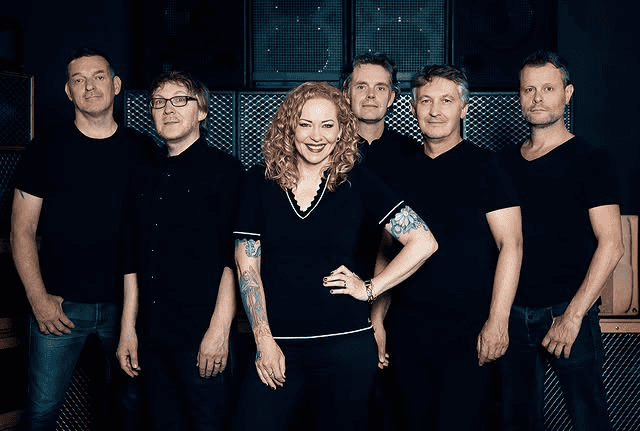
“In the vast landscape of atmospheric rock, very few bands have mastered the art of sonic metamorphosis like The Gathering. From the pioneering shadows of gothic doom to the ethereal heights of ‘Mandylion’ and their current trip-rock explorations, the Dutch visionaries have always stayed true to their emotional core. Today, at Soundstoriesbyjo, metalwar.gr, we are honored to host a conversation that dives deep into the heart of their sound, discussing the narrative of their long journey and the creative sparks that keep their ‘disclosure’ alive in 2026.”
“Hi Hans,
Thank you once again for your prompt reply and for being open to this discussion. I truly respect your time, so I have carefully selected 10 essential questions that avoid the typical ‘promo’ talk and focus on the deeper ‘sound stories’ of the band. We are thrilled to host The Gathering across our network in Greece (SoundStoriesByJo, and Metalwar, )
Here they are:
Jo: “Beautiful Distortion” felt like a very organic and deep record. Now that some time has passed, how do you feel it sits within the band’s vast discography? Does it represent the ‘now’ of The Gathering as you envisioned it?
Hans: A new album is always a moment in time, a snapshot of the band’s current state. That’s also true for Beautiful Distortion. It’s the album we made after that strange coronavirus period, with all the obstacles that came our way. It’s a beautiful, honest album, well-recorded, and I’m still very proud of it. Unfortunately, it didn’t get the attention it deserves. For me personally, it’s a kind of sister album to How to Measure a Planet. Because of Attie Bauw, who produced both albums, of course, but also because of the entire atmosphere it exudes.
Jo: From the doom/death era to the trip-rock and atmospheric sounds of today, The Gathering has always been ‘restless’. Is this constant evolution a conscious decision to avoid labels, or just the natural result of your personal growth as musicians?
Hans: From the very beginning, we’ve always had the idea not to stagnate in any particular style or movement for too long. The key was always to embark on a musical journey of discovery. It’s in our DNA. You develop as a person, and we believe you should develop as musicians as well. This applies to technique and playing experience, but also to songwriting, arranging, and live performances.
Jo: Our platform is called SoundStoriesByJo. If you had to pick one album from your career that tells the most ‘honest’ story of who Hans Rutten is as a creator, which one would it be and why?
Hans: That would be our first album, ‘Always…’. Because it is our most honest album and probably the writing process was the most intense of all albums we recorded .
Recorded very simple and no computers involved in the whole process. Arrangement wise the songs on this album are so mature and clever. The basic tracks (drums, bass and guitars) are recorded live in one take. Just by playing live and pickt the best version. And given the fact we were all teenagers, it makes the myth around that album even bigger.
Jo: The Gathering’s music has a very specific ‘cinematic’ quality. When you are composing, do you visualize images or stories, or is it purely an emotional and sonic exploration?
Hans: When we’re in songwriting mode, we pull out all the stops to make a song sound as good as possible. We listen to different music and different genres, of course, but also excerpts from films, books, cultures, and even travelling to other countries are influences. We talk a lot about the ideas we have and where they should go. I find this process very satisfying; the best moment is putting a song together and realizing that it works, that you’ve written a beautiful song.
Jo: “The Gathering’s music often feels like a delicate balance between deep melancholy and a sense of hope. How difficult is it to capture these conflicting emotions in a single song, and where do you usually draw your inspiration from when creating these bittersweet soundscapes?”
Hans: As said, inspiration comes from a lot of cultural aspects around us. Music, but also movies, books, travelling. It is not difficult, at least not for us. We just listen to our own ideas and start working.
Jo: The Gathering has a very deep, emotional bond with the Greek audience since the ‘Mandylion’ days. Why do you think your music resonates so strongly with the Greek spirit?
Hans: I really have no idea why we do better in some countries, while others pay less attention to us. It doesn’t matter, as long as you have an audience that believes in you. It’s a huge honor for a band to have people around you who are so invested in your music and that the band is so important in their lives. The Greeks know what culture is, and maybe they’re also melancholic, just like us.
Jo: “We are thrilled to have you back in Greece this April for two special shows in Thessaloniki and Athens. What made you choose this specific atmospheric/acoustic approach for these dates, and what kind of ‘sound journey’ should the Greek fans expect this time?”
Hans: We’re playing at two fantastic venues in Greece. We were simply approached, and the booking agent suggested these two shows. We’re definitely looking forward to it! We’ll be playing Mandylion, and a nice cross-section of the band’s “Anneke” period. It’s definitely going to be something unique, and you never know when we’ll be back.
Jo: In your music, the ‘space’ between the notes seems just as important as the notes themselves. How do you manage to maintain such a delicate atmospheric balance after all these years?
Hans: A kind of primal instinct? I think we achieve that by not overthinking it and just doing what we have to do. It’s mainly a matter of listening carefully to the ideas you have, and in a band, also listening carefully to each other, and the producer, of course. You have to be completely open and approach the process with an open mind, knowing what you’re going to do.
Jo: “After a decade of studio silence, ‘Beautiful Distortion’ emerged as a deeply layered and sophisticated album. Looking back at the sessions, did you feel that this record was a necessary ‘re-connection’ for the band members, and how do you feel the audience’s perception of your music has shifted in this post-hiatus era?”
Hans: The writing and recording process for Beautiful Distortion was incredibly strange. Of course, we faced the challenge of being in the midst of the coronavirus pandemic when we started writing. Yes, we were actively back together as a band, but because of the pandemic, it didn’t feel that way. We had to do everything remotely and communicate online. Yet, we managed to create a truly human, warm record. Unfortunately, the record received far too little attention because everyone released a record and went on tour after the pandemic. We kind of drowned then, commercially speaking. The record deserves more.
Jo: “Looking at the fans who have followed you for over 30 years, as well as the younger generations discovering ‘Mandylion’ or ‘How to Measure a Planet?’ today, how does it feel to know that your music has become a permanent ‘anchor’ for people’s emotions? Do you create music with the intention of it being timeless, or is it purely a ‘snapshot’ of a specific moment in your lives?”
Hans: Of course, when you write something, you hope it will later be labeled “timeless”, but it is always a snapshot of what you are doing at that moment. When you’re in the middle of the recording process, you don’t think about that at all. It’s also subjective, of course. What’s timeless, and what isn’t? We’ve always tried to make choices that ensure we don’t follow too much of a fad. We don’t suddenly do something just because it’s hip.
I think records like “How to Measure a Planet” and “Souvenirs” have such a production and fresh sound that they can last a long time. Yes, it is a great honour if we hear from people that our music still resonates so much in their lives. It’s the best compliment you can get.
Jo: “Thank you for your time and for the music that has been a soundtrack to our lives for so many decades. We are eagerly looking forward to your insights and, of course, to your monumental return to Greece in 2026.
Hans: Thanks as well and talk soon!
Cheers, Hans / the Gathering.
Interview – Text: Jo Gonas