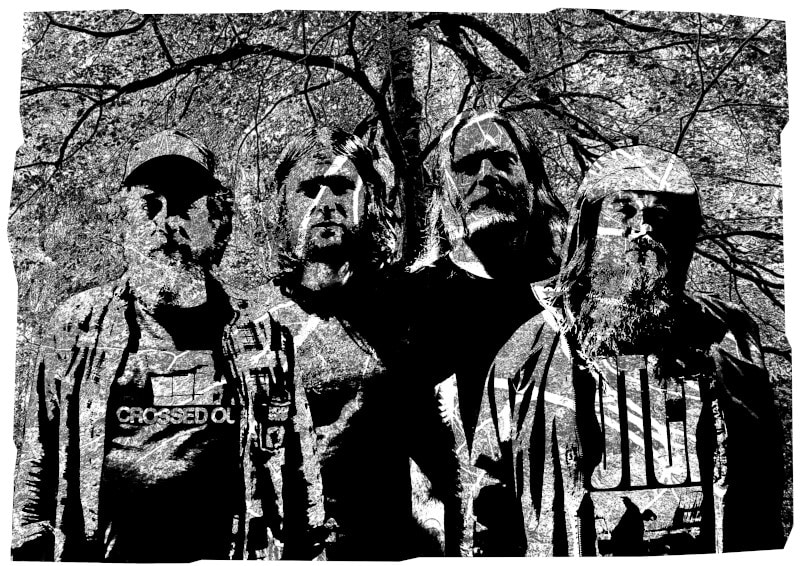

Tsatthoggua is a controversial and influential Black/Thrash Metal band hailing from Germany. Active initially from the early 1990s until 2000, and reactivated around 2019, the band is known for its extreme sound and highly provocative imagery and lyrical themes.
They are primarily categorized as Black/Thrash Metal or sometimes “Satanic Hyperspeed Metal.” Their music is fast, raw, and often described as brutal and bizarre.
Tsatthoggua is famous for lyrics and aesthetics heavily focused on Sadomasochism (BDSM), Fetishism, and explicit Anti-Christianity. They often incorporate leather and latex masks into their stage presence to emphasize these themes.
Jo: To begin, could each of you introduce yourselves and tell us what part of the Tsatthoggua madness you’re responsible for — on stage or in the studio?
Nar: Hi Jo, I’m a founding member of the band, and since the beginning I’ve been responsible for all the musical output we’ve released up to this day. As the sole guitarist, I handle the guitar work in the studio and on stage, contribute to the songwriting, and also write part of the lyrics.
Jo: After years of silence, you returned with ¨”We Are God” — an album that feels both defiant and transcendent. What does this title mean to you personally, and what statement were you making with this comeback?
Nar: “We Are God” is a declaration of autonomy. Not divinity in a religious sense, but in a human one — the power to shape, destroy, reinvent. After so many dormant years, the title was our way of saying: we never disappeared; we simply returned with clearer focus. It’s a reminder that creation and defiance can be inseparable. It also reflects our view that we reject organized religions and the idea of a single higher power — instead, we believe that each person is their own god, free in their decisions and in their will.
Jo: Tsatthoggua’s sound has always walked the line between chaos and control — how do you know when a track has reached the perfect level of insanity?
Nar: When the music stops sounding “composed” and starts sounding like it’s trying to escape us. We push a track until it threatens to collapse — then we give it just enough bones to stand. The perfect point is where frenzy becomes intentional.
Jo: Many of your lyrics mix eroticism, blasphemy, and cosmic horror. Do you see these themes as rebellion, philosophy, or pure artistic expression?
Nar: They’re all the same thing. Rebellion is philosophy expressed physically, and philosophy becomes art when you stop filtering it. Eroticism, horror, and sacrilege are just the textures of instinct — the parts of the human psyche that refuse to behave.
Jo: The name Tsatthoggua comes from Lovecraftian mythology — do you feel a spiritual or symbolic connection to that entity, or was it more of a metaphor when you chose it?
Nar: It was symbolic, though symbols can grow teeth. Tsatthoggua represents the ancient, the dormant, the grotesquely powerful. We connected with that idea — a force that appears lazy or sleeping but holds catastrophic potential. It fit our sound better than any conventional name.
Jo: When you re-entered the studio after so many years, what was the first sound or riff that reminded you, “Yes — this is still Tsatthoggua”?
Nar: I think it was the first two parts of “Vorwärts Vernichter” that reminded me. Those dirty, jerky guitar lines felt like a hungry animal waking up — exactly the mix of grime and menace we associated with our sound. Once those riffs were in place, the rest of the album naturally found its rhythm.
Jo: Your imagery has always been provocative — latex, masks, fetishistic symbolism. What role does visual shock play in expressing the music’s core ideas?
Nar: Shock is just the doorway. The point isn’t to provoke for its own sake; it’s to embody the mood of the music — the surrender, the danger, the pleasure in fear. The visuals tell the audience: “You’re leaving the ordinary world now.”
Jo: If “We Are God” were a film, what kind of atmosphere, setting, or story would it have?
Nar: A neon-lit dystopia where ritual and nightlife blur together. Something like a fever dream inside an abandoned nightclub-temple. The story wouldn’t be linear — it would follow a character descending into empowerment, guided by desire and chaos rather than morality.
Jo: Is there a particular song on the new album that captures the current soul of Tsatthoggua more than any other?
Nar: Actually, not really — at least, no single song comes to mind that captures it completely. I’d rather say that the entire album reflects our current mood. It’s a new, atypical, and probably more mature approach compared to the path we followed back in the ’90s.
Jo: You’ve worked in an era before social media and now in one dominated by it — how has that shift changed the way you connect (or refuse to connect) with your audience?
Nar: Back then, mystique was completely natural. Today, it has to be deliberately created. In general, we enjoy interacting with our fans in this way. We still prefer to let the music speak for itself, but we appreciate that people can now reach us directly — it makes the chaos more communal.
Jo: Tsatthoggua’s music feels like a collision between ecstasy and destruction. When you write, do you start from emotion, concept, or pure sonic experimentation?
Nar: Emotion first, concept second, sound last — but they overlap quickly. Usually there’s a spark: anger, lust, amusement at the absurdity of existence. That emotion becomes a concept, and the instruments translate it into violence or seduction.
Jo: What’s the most misunderstood thing about Tsatthoggua — musically or philosophically?
Nar: People assume we’re trying to shock or offend. In truth, we’re exploring extremes because they’re honest. The grotesque can be beautiful. The sacred can be corrupt. We’re not preaching; we’re documenting.
Jo: If you could summon a feeling or force from your music directly into reality, what would it be and why?
Nar: Liberation. Not the peaceful kind — the kind that rips away everything that binds you, even the illusions you cling to. The world could use fewer chains, even if the process of breaking them is loud.
Jo: After “We Are God”, do you see this as the beginning of a new era for Tsatthoggua — or the closing of an old, unholy circle?
Nar: Both. The circle closes so another can open. We have risen again. In our principles, we still embody what we were 30 years ago — only now more mature and not quite as chaotic. We try to give the chaos more structure. Back then, I wanted to provoke, shock, and clash with expectations. Today, we want to have fun and enjoy our time together, as long as we still can.
Jo: Finally — if Tsatthoggua were a message whispered to the world after the apocalypse, what would it say?
Nar: “Create something beautiful from the ruins — and don’t be afraid if it terrifies you.”
Jo: Thank you, Tsatthoggua, for your uncompromising music and controversial vision. Your contribution to the extreme metal scene, particularly with your unique blend of Black/Thrash and challenging thematic material, remains a significant and unforgettable chapter in the genre’s history.
Nar: Thank you, Jo, for your interest in our band and the art we represent. I also appreciate the very interesting questions, which allowed for a different form of discussion.
interview – text: Joanna Gonas