The emotional charge is quite strong every time we refer to the name Astarte, and by extension to the name Tristessa, not only because of what she offered to the Greek scene, but also for the legacy she has left behind.
Astarte is the benchmark band of the Greek heavy metal and black metal scene, formed in 1995 under the original name Lloth, and is globally pioneering as the first all-female black metal band.
They initially began with a black metal style, influenced by the cold and melancholic standards of the dark Norwegian black metal scene.
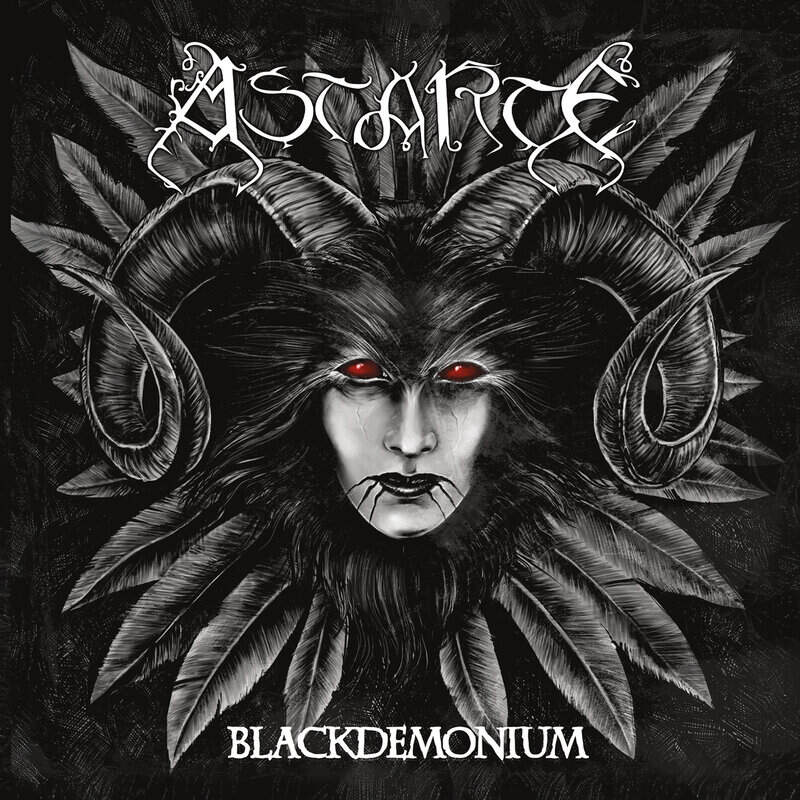
The band’s discographic return, eighteen years after their last full-length “Demonized”, also marks their “swan song”, as with “Blackdemonium”, the chapter of Astarte comes to a close.
Maria may no longer be with us, but her voice will be heard again—louder than ever!
On the album—which was almost ready to be released before Tristessa’s passing—dominates an extreme, dark metal sound with many references to death/thrash styles, filled with storming riffs, blast beats, and fast tempos.
The production is raw, unpolished—perhaps there was room for improvement here, as well as in the overall instrumental balance of the tracks, with a bit more attention to compression and separation.
The songs are relatively short in duration, something that makes the album more direct and easier to grasp for the listener, although I could imagine some ideas being developed further.
Perhaps a few slower parts could have given our ears a break from the continuous bursts—especially of the drums—but that didn’t really bother me much.
At first listen, the album thrilled me; with more listens, some minor “issues” became noticeable—like certain repetitive drum patterns throughout the album.
The assault begins immediately after the intro track, with the title song, and doesn’t stop until the very end—something that will please those who enjoy raw blackened death/thrash.
Maria’s chaotic, demonic vocals are unmatched, perfectly complementing those of Nicolas Maiis.
The third track, “Monolith”, one of the best on “Blackdemonium”, evokes the most memories, with its references to the past.
“War” continues the onslaught until the uniquely melodic “Darkness (Will Rise)” takes its place as another of the album’s strongest moments.
The album’s strongest element is the guitars, which—drawing from the Scandinavian metal scene—give “Blackdemonium” its character, both through their amazing riffs and their melodies.
Overall, “Blackdemonium” holds emotional value, but it would be unfair to ignore its musical value as well, since it is a very good album.
Thus, with the final twenty-nine creative minutes of Astarte, a bright–dark circle closes for one of the most important figures—and bands—of the Greek and international metal scene.
Spyros Tribos
8/10