
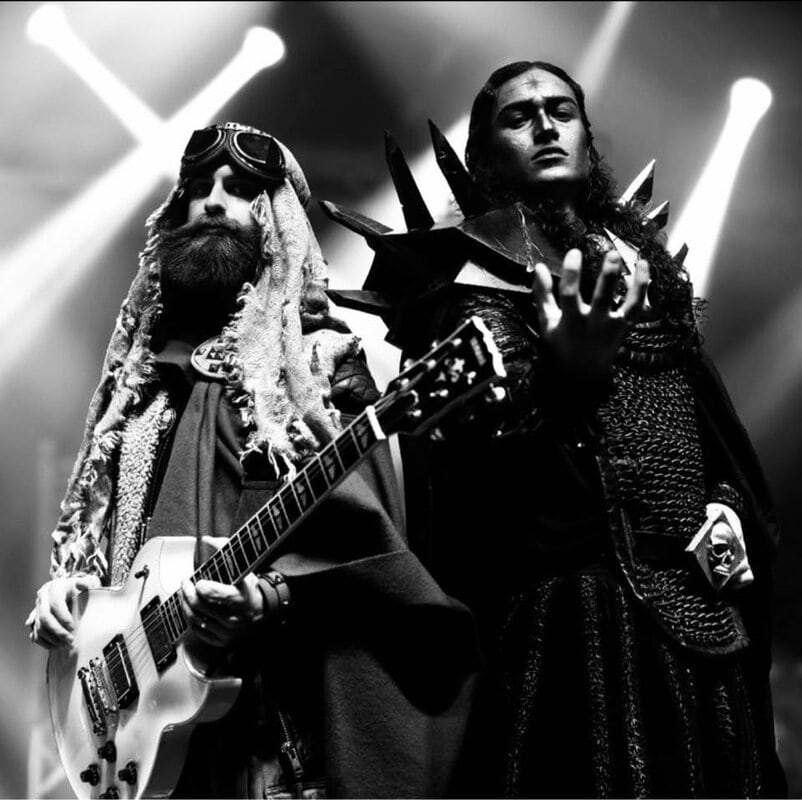
When the echoes of the 70s progressive giants meet the urgent, modern call for spiritual justice, Crown Lands emerges as the definitive sonic bridge. With their multi-instrumental mastery sounding like a majestic tribute to the gods of Rock and their deep connection to ancestral wisdom, Kevin Comeau and Cody Bowles are rewriting the rules of the genre. Today, at Sound Stories by Jo and metalwar.gr, we immerse ourselves in the ethereal universe of the Canadian duo for a conversation about the Fearless creative spirit, the power of heritage, and the relentless pursuit of musical truth.
12+1 questions
Jo: Your music is often described as fearless. In an industry that often favors 3- minute radio hits, how do you protect your 10-minute progressive epics from being compromised? Is length a form of artistic rebellion for you?
Cody: We have been very lucky from an early time in our career, to be blessed with the ability to do whatever we wanted creatively. Lucky for us, we have always surrounded ourselves with people who are privy to the prog weirdos we are and our bizarre song length choices we love to make. We have usually also paired these longer songs with shorter musical offerings, so it sort of balances things out at the end of the day.
Jo: You’ve been called the successors of Rush, which is a huge honor but also a heavy crown. How do you embrace this influence while ensuring that the Crown Lands identity remains distinct and contemporary?
Cody: We wear this influence on our sleeve with pride and honour. Rush are and have always been our favorite and biggest influence– both musical and otherwise– so to get this comparison is something we do not take lightly. We are ultimately ourselves and have a myriad of musical influences, from Rush, to Queen, to Pink Floyd, and even Jeff
Buckley to name a few. So, while I may have a higher pitched singing voice, and Kev might draw from a very 80’s Rush guitar sound, it isn’t always the case and we are at the end of the day, always being ourselves when we pick up our instruments. We blend that gumbo of retro sound with our modern worldview and our own flavour of storytelling to reflect the world around us, or even to create new ones among the stars.
Jo: Being a duo that sounds like a 5-piece band is a technical marvel. What is the most challenging part of performing such complex arrangements live while maintaining that raw, organic connection between just two people?
Cody: For me, the most challenging part of performing our arrangements live is maintaining good posture and diaphragmatic breath support to do all of the incredibly demanding acrobating vocal work that our songs demand. The more complex the drum part whilst I sing, the more concerted the effort and the more I really have to focus on not messing up the lyrics, haha!
Jo: Your live shows feel like a journey. Do you view your concerts as a performance or as a shared spiritual ritual with the audience? What do you hope someone feels the moment the last note fades out?
Cody: I see every live art performance, music or otherwise, as a shared spiritual connection of sorts between the performer and the audience/observer. I believe that the energy exchange of these performances are special and it’s in these moments that as a performer, you have the opportunity to speak to someone’s heart, help them through something difficult in their lives, or tell them what they needed to hear after the troubles of daily life. To be that escape for someone is like a doorway to another world, and I just hope that people feel the soul we pour out on stage night after night for them to enjoy and take out of it what they need most.
Jo: Kevin, your use of double-neck guitars and Moog Taurus pedals is legendary among gearheads. How do you decide when a song needs more space and when it needs that massive, symphonic wall of sound?
Kevin: We try to write our music with dynamics in mind as much as possible. Each section needs its own sonic identity, so we normally will allow verses to breathe with a bunch of space: acoustic guitars, or cleaner tones, and then big taurus bombs and big oberheim synth moments in the chorus or bridge. We try not to get too formulaic with it but there is a strong Crown Lands sonic identity that has developed over the last 2 records. Sometimes I just can’t help myself and I record three-part guitar monies, a big, busy bass part, taurus bombs, silly Minimoog leads all in one section of a song. Apocalypse is full of big moments like that. It’s got everything I love about music in there.
Jo: Progressive rock has always been about moving forward. What does Progressive mean to you in 2026? Is it about technicality, or is it about the message behind the music?
Cody: “Progressive” in 2026 means to me that we are making music that makes you think. Whether it’s a long or short piece of music, whether the time signature stays the same, as long as it has an element to it that scratches your brain in a particular way I would say it’s Progressive. I especially am fond of the messages behind the music, and deeper meanings within them. I think having music take you on a journey that makes you reflect on the state of the world around you is as progressive as you can get in this day and age.
Jo: Your music often feels very outdoor and grounded in the natural world. Does the Canadian landscape act as a silent third member during your writing sessions?
Cody: During the writing/recording of our Ritual records, I must admit the natural world did make an imprint—but that was entirely intentional. We wanted that record to act as a bridge into the natural past of Karagon’s ancient history. For our other works, imbuing them with the feeling of the natural world isn’t really drawn from where we are necessarily, as we usually write in a very small room and often get most of our best ideas in said small sweaty room when we are only focused on the music. I suppose that element must come from us or the flutes we love to sneak into our longer arrangements.
Jo: You don’t shy away from difficult topics like the Missing and Murdered Indigenous Women. Do you believe that Rock music has lost its edge as a tool for social change, and are you trying to reclaim that power?
Cody: I firmly believe that as an artist, one must use their platform to talk about things that are important in the world around them. It feels like this sort of thing is our duty, not only as entertainers, but as artists who spread their influence wherever they go.
I think that a lot of music has lost its edge or rather, it isn’t being made with the same intentions as it used to. While that’s entirely okay in the grand scheme, we have never been a band to just sing about anything. We need to talk about things like Missing and Murdered Indigenous Women, the injustices Indigenous people face throughout the world, and the state of the world at large today. To reflect and amplify those voices, I
believe there is an opportunity for real discourse, conversation, and education that can lead to a better world.
Jo: Beyond the obvious giants, which underground 70s artists have influenced the more experimental side of Crown Lands that people might not expect?
Cody: I’ve been influenced quite a bit by this french progressive rock band called Magma. Their use of a completely fictional language for most of their catalogue and their own created world was an influence on me when we started creating our world of Fearless.
Jo: Having worked with a producer of such caliber, what was the most important studio lesson you learned that changed the way you perceive your own songs?
Kevin: We’re so lucky to have worked with our absolute heroes. Working with Terry Brown, David Bottrill, Dave Cobb, and Nick Raskulinecz over the last 4 records has been like going to music school. I’ve learned so much from each of them about writing, arranging, recording, producing, mixing… everything about making music. One of the biggest takeaway from these sessions has been working with each of them on getting drum sounds. The hardest part of making a record is getting a great drum sound. Almost everything else can be done with one microphone but drums (especially something large like Cody’s drumkit) can take up to 32 inputs.
There are a lot of mics to make sure are patched correctly, gain staged, correctly, everything is working in phase, etc. it’s a difficult part of the process to master and this was the first album that I undertook that myself. Nick was a huge inspiration for me. He helped us record the drums for a few of the songs on this album and he was so generous with his knowledge to me. I learned so much about getting killer heavy rock drum sounds by working with him. I’m so proud of the tones we got on this record!
Jo: With the world moving faster than ever, do you think people still have the patience for long-form musical storytelling? Why is it important to keep the concept album alive?
Kevin: Absolutely, it’s our mission to keep long-form musical storytelling alive. As rock music moves further out of the mainstream world, the niche subgenres become more important. Grand story-telling Prog is my favorite kind of music and it truly changed my life when I started listening to it. That magic still exists in the world today and that
artform needs to be preserved. We’re doing our best to keep that tradition of Concept Albums alive for the following generations of musicians. If bands like us don’t keep it going, then all we have left is the classics. This format needs to be kept alive so it can keep growing and evolving.
Jo (+1): If Crown Lands were a constellation in the night sky, what story would it tell to the generations that look up a thousand years from now?
Kevin: Wow, what a beautiful question. It would be an epic interstellar tale of good versus evil. The righteous against the villainous. I hope our Fearless Chronology reminds people of what really matters: love over hate, and hope over greed. Also, I hope that the constellation shines in ⅞ time.
From the vast landscapes of Canada to the global progressive stage, Crown Lands remains a beacon of musical integrity. Thank you for your time and for the starlight you continue to share.
Kevin: Thank you! We appreciate you taking the time!
Interview – Text: Joanna Gonas


No comments yet. Be the first to comment!