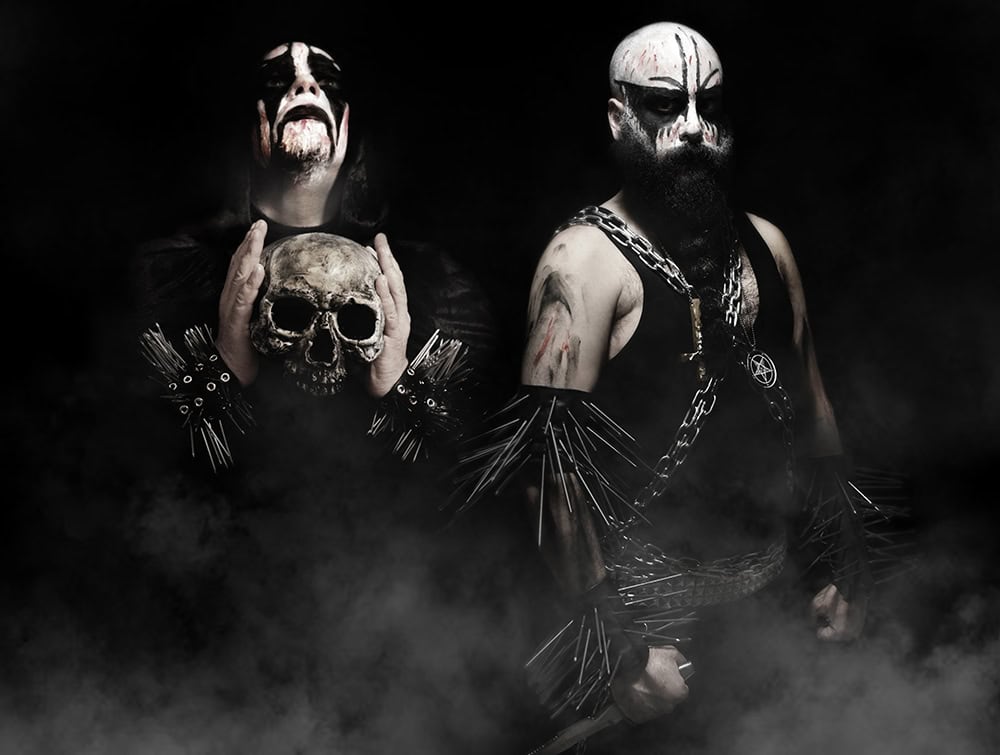
A few months ago, and more specifically on November 21st, 2025, Temple of Katharsis released their new second album, “Worshipers of the Ancient Necromancy”. On the occasion of this release, Metalwar got in touch with Hellmaster 666 (vocals, bass) to learn all the essential details.
Metalwar: “Worshipers Of The Ancient Necromancy” feels more like a ritual than a simple album. Do you see it that way as well?
Hellmaster 666: I would say it’s a bit of both. It definitely has a ritualistic feeling, but I believe you can also describe it as a black metal album. It depends on how each person perceives it.
Metalwar: Compared to “Macabre Ritual”, what is the darkest evolution this new work brings?
Hellmaster 666: Perhaps the fact that it is connected to ancient necromancy and deals with its entire history makes it, I would say, darker than its predecessor.
Metalwar: Your sound combines the Greek black metal atmosphere with Scandinavian ferocity. Is this “fusion of schools” a conscious choice?
Hellmaster 666: Of course it is. From our very first steps, I remember us trying to create a kind of union between these two schools, and over the years this has naturally come through and become fully intentional.
Metalwar: The lyrics touch on necromancy, ancient magic, and spiritual decay. Are these symbolic elements or clearly occult themes?
Hellmaster 666: I would say they are clearly occult themes.
Metalwar: “Celebrating the Coronation of Grand Evil” sounds like a hymn to a dark enthronement. What is the “Grand Evil” for you?
Hellmaster 666: The Grand Evil for us is Satan. The serpent of the abyss who is crowned victorious on his throne against the kingdom of heaven. Essentially, it is also a celebration—if you want to put it that way—of the victory of evil over… “good.”
Metalwar: Most of the composition went through Zeratul. How is the band’s collective identity maintained with such a concentrated creative control?
Hellmaster 666: Look… the songwriting process works like this: for example, I might have the initial riff—the skeleton of the song, let’s say—which I then give to Zeratul, and he builds upon it. Many times, the riffs are entirely his and I fully agree with them, because we have very good chemistry and a strong bond between us. That plays a very important role in the overall creative control.
Metalwar: The production maintains a raw yet ritualistic character. Did you want it to sound like a “ritual recording” rather than a modern studio production?
Hellmaster 666: I definitely lean more toward “ritual recording” rather than modern production. No, not modern.
Once we found this sound, we said that it fit this album perfectly. It’s a more old-school production compared to Macabre Ritual.
Metalwar: The name Temple of Katharsis refers to purification through darkness. Does your music aim to offer a spiritual experience for the listener?
Hellmaster 666: Yes and no. I came up with the name many years ago, and back then I didn’t exactly have a spiritual experience for the listener in mind. But over the years, I partly believe that we have managed to achieve something like that.
Metalwar: How important is mysticism to the image and existence of the band?
Hellmaster 666: On this album, it is quite important. But in general, we lean more toward a satanic–dark aesthetic. Still, yes—on this particular album, the element of mysticism needs to be intense.
Metalwar: The artwork by Wolf’s Path exudes an otherworldly sense of sacredness. How closely do you work with visual artists to properly “dress” the work?
Hellmaster 666: We wanted something dark, otherworldly, old school, and of course without color. Since they are people close to us, they immediately understood what we wanted, and I believe the final result justifies us.
Metalwar: If someone listens to Temple of Katharsis for the first time, what do you want them to feel: fear, awe, or attraction to the unknown?
Hellmaster 666: Mmmm… well, difficult question. But I would say a bit of everything, in the right proportions! haha!