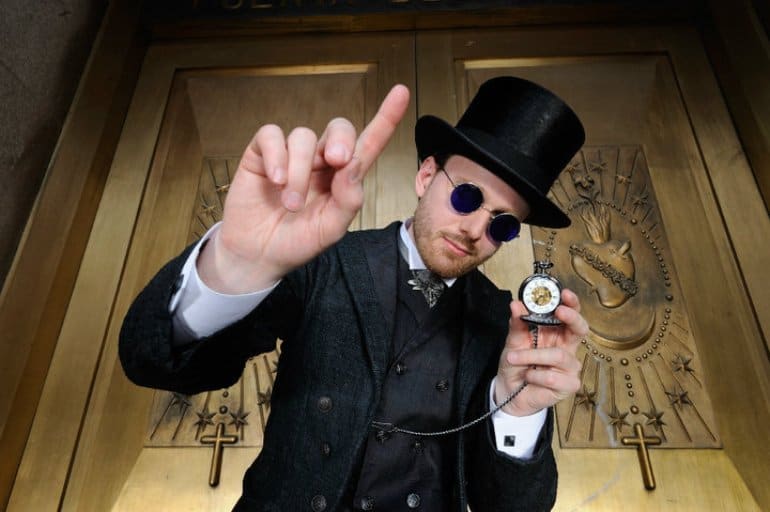
“There are bands that follow history and bands that create it. Christofer Johnsson undoubtedly belongs to the latter. From the raw death metal of the early days to the creation of the symphonic monumentalism known as Therion, Christofer has remained an unapologetic visionary.
Today, at Metal War , we have the honor of hosting the man who fused opera with metal, transforming myths and occultism into sonic masterpieces. In a conversation that transcends the boundaries of a typical interview, Christofer guides us through the world of the Leviathan trilogy, reminisces about legendary nights in Athens, and shares the ‘stories’ behind the music that forever changed the face of European metal.
The interview was edited by Joanna Gonas https://soundstoriesbyjoblog.wordpress.com/
Ladies and gentlemen, Christofer Johnsson of Therion.”
Jo: “Your latest masterpiece, Leviathan III, completed an ambitious trilogy. Looking back at the recording process, which song from this final chapter do you feel represents the ‘Therion of today’ the most, and are there already any ‘soundstories’ brewing for your next musical step?”
Christopher: I think “The Ruler Of Tamag” is the best example of our new way of writing with me and Thomas as a team. I think it’s the best song on the album and also the most fun to perform as a guitarist. It is also the most popular song on the album among the fans, so I think that song has to be the one you are asking for.
Jo: Now that the Leviathan trilogy is complete, looking back, do you feel this project was a return to the “soul” of Therion, or a new blueprint for the band’s future?
Christopher: Neither. It was a project where we, for the first time ever, tried to give the fans what they wanted. So it was something new and different conceptually, even though we tried to find the secret sauce from the past that people liked the most.
We have no idea how the next album will sound like, but we are going back to just writing songs spontaneously without any specific thought behind them, so the Leviathan trilogy will forever stick out as something different conceptually.
Jo: Greece has always been a “fortress” for Therion. Why do you think your operatic and occult metal resonates so deeply with the Greek spirit?
Christopher: I don’t know how to answer that question without lying to our Greek fans in this interview (which would feel very disrespectful), so I think I’ll just tell the truth instead. Greece is for sure one of the better markets for us – in Europe. Therion is doing best in the eastern half of Europe, from Poland in the north down to Greece in the south. But globally speaking, both Greece and the rest of Europe (except Poland) is dwarfed by the success we have in Latin America (the 12 countries we have played there), Turkey (sorry…), Russia and China. So I don’t feel Greece is sticking out as much as you suggest to be honest. And while the crowd in Thessaloniki is passionate and we always had an awesome show there, we have never pulled more than 200-400 people there (250 last time), so nothing spectacular in terms of number of fans. Don’t misunderstand me though, it’s more fun playing in front of 250 crazy Greeks in the beautiful city of Thessaloniki than 250 laid back Germans who are bored because they have already seen all their fave bands live 10 times already.
So the reason the fans in Greece resonate well with what we do is exactly the same reason that fans do it in other places. To me anyone anywhere who listens to my music is part of the extended Therion family. And we had amazing shows in so many different sizes and environments; Mexico with a 11.000 seat sold out arena, in Thessaloniki with a few hundred people and in Aberdeen in Scotland in front of only 70 people (but who still made the evening unforgettable due to being super devoted and passionate).
Jo: Throughout your career, the occult has been a central pillar. How has your personal understanding of these mysteries evolved from the days of Theli to the present?
Christopher: I don’t know why you mention Theli as some sort of starting point. I started to introduce occult ideas in our lyrics already in 1992 with our second album Beyond Sanctorum.
But to answer your question; I think my understanding has become more laid back and less dramatic. It manifests in the way that in the young years it was more about discovering new things, when you get older it is more about what use you put what you previously discovered to.
Jo: You are known for blending classical music with heavy metal. When you compose, do you see the music in “colors” or “scenes,” almost like a cinematic director?
Christopher: We blend many things. Additionally to what you mentioned, there are also 70’s hard rock, various folk music, progressive rock, pop elements and more.
Sorry if I sound boring, but I just write songs I like, simple as that. Nothing pretentious or extravagant in the creative process.
Jo: Looking at the current state of the symphonic metal scene, which you practically invented, do you feel it has stayed true to its roots or has it become too “polished” and commercial?
Christopher: I don’t think we invented most of it. Bands like Celtic Frost already did symphonic metal in the 1980’s. But they just did a few songs like that. Just like Therion had a few symphonic metal songs on our second and third album, but didn’t go all the way. I think what we did was that we defined it and became the first band to fully embrace that sound and of course develop the concept further.
So while we didn’t invent symphonic metal, we became the first fully symphonic metal band. I think we were the first established metal band to not have a permanent vocalist and instead use a variety of session voices in the studio and live though. That’s a concept I may very well have invented.
But to answer the core of your question: Symphonic metal today is definitely more commercial and polished as you suggest. But I have nothing against that, we did several commercial songs with Therion too.
But the majority of the bands today seem to have a bigger aim on it than us and some of the bands seem to entirely focus on it (like Sirenia, a good band who is making a very ”radio friendly” and poppy version of symphonic metal). That is not a form of criticism at all, just an observation. If bands make music and there is a big amount of people who love what they do, then it’s a positive thing in my book. I’m even a big fan of a lot of very commercial pop music. For example, I’m a huge fan of the Beatles and ABBA.
Jo: Our platform focuses on the “stories behind the sound.” Metal War Radio. Is there a specific myth or historical event that you haven’t explored yet but feel it’s calling for a Therion soundtrack?
Christopher: Truth is that it’s getting harder to find new topics without being repetitive to write about after 18 albums with occult themed lyrics. On one hand there are for sure many more myths and spiritual topics left to write about, but on the other hand our knowledge of them is limited. Up til now it was always like ”Let’s write a lyric about that!” because it was something we already knew of that we thought deserved a lyric.
In the future I may have to do some research for new topics and I’m kind of sitting on the fence whether that is good or not. On one hand I think it feels less genuine to try to search for new topics rather than writing about things we already know. But on the other hand; if the lack of topics leads to a kick in the arse to motivate studying new topics, then I will extend my knowledge and isn’t that a good thing? I don’t know. Next Therion album will be out in 2028, so I have plenty of time to sleep on it.
Jo: You’ve worked with incredible singers over the decades. How do you manage to maintain the “Therion DNA” while constantly changing the vocal textures?
Christopher: I try to just play by ear and work with what I’ve got as far as possible. If I feel there is a need for a different voice, I usually ask around in my contact network and see if there’s something interesting that could fit.
I think the core part of the Therion DNA actually is the vast diversity of styles, sounds and performers.
Jo: In an era of AI-generated music and digital perfection, how important is the “human element” and the organic feeling in your recordings?
Christopher: Despite the type of music we do, we try to keep as much ”rock n roll” vibe in the music as we can. We try to keep a good natural swing and groove in the playing of the band. And every time we recorded with a real orchestra, they did it primarily vista – no rehearsals or practise before. For later albums, we worked with VSL (the most advanced orchestral sample library – most of the film music you hear is made with it), but then tried to humanize it a lot rather than look for perfection.
I prefer the sound of analog tape, but we benefit greatly from digital recording, where we can have an almost unlimited number of channels. I don’t miss the analog recording days at all.
It was always a pain in the ass as you can’t edit the takes (like cutting together two good parts of two different takes) recording analog and we always had huge problems with channels not being enough. Today we sometimes use over 200 channels in some songs, In the analog days we were restricted to 48 channels (1998-2000 we extended it with 16 more tracks from digital tape that we had to add).
AI will sadly replace 90% of human composition with that.
It can’t be stopped. It’s like when cinema came and made theater a small niche. Human made music will always have a space, but it will become more like classical music (state subventioned and a bit posh) and fusion jazz (more underground at clubs with very devoted listeners). It’s a generational thing.
You and I don’t want to hear an AI-generated copy of our fave bands. Some dinosaurs like me even still buy and listen to physical mediums like CD’s and vinyl. But the generation that grew up with AI will have no problem with it. Due to this generational aspect, it doesn’t matter to my generation of bands and older. We have our crowd and will just continue to do what we do. But being 16 years old today and starting your first band… that’s like being 16 years old in 1950 and dreaming about becoming a steam train driver or oil painter.
Jo: Do you have a specific memory or a story from your visits to our city that still stands out to you?
Christopher: Yes. We had a cancelled show there on the tour in 2012 (too few tickets sold, so the promoter cancelled). It sucked and I met a bunch of very sad fans that were outside the venue early in the day waiting and I had the idea we could do an unplugged show at some pub, just not to let the fans down and to have something fun to do ourselves.
We never played unplugged before that and we didn’t even really know how to transform the songs to acoustic versions. So we just had a beer and improvised the arrangements the best we could. That became a very special evening and thanks to that I later got the idea to do a few more (properly rehearsed) unplugged shows some year later.
Our show there 1997 is also a strong memory, it was a very explosive show. And the local sound engineer was called Alkis, which we thought was very fun, as that is a slang word in Swedish language for an alcoholic.
Maybe he was, because he forgot to put on my microphone for half of the opening track…
Jo: You moved to Malta some years ago. Has this change of scenery and the Mediterranean atmosphere influenced the way you perceive your art today?
Christopher: Yes, I am more chilled here with the slower Mediterranean pace and warmer climate. It has really done me good. I could never imagine living in a stressy cold country again.
I am not sure if this has affected my view on art that much, but given the fact that I have been a lot more productive in terms of songwriting down here, I guess it must have had some sort of overall positive effect.
Jo: If the music of Therion was a portal to another dimension, where do you think it would lead the listener right now?
Christopher: Several of our songs make me think of astral experiences.
Jo: What would you like to say to the Greek fans who have been following “Metal War radio”?
Christopher: Thank you SO MUCH for being with us all those years. We’ve had so many good times there.
“The journey into the world of Therion never truly ends, as every note composed by Christofer Johnsson is a portal to the unknown. We would like to deeply thank him for his time and for the honesty with which he shared his thoughts with us.
For us here at Metal War Radio, the music of Therion will always be the ultimate guide to the ‘sound stories’ we insist on seeking. Stay tuned, for the next chapter of the symphony is already on its way.
The Symphony remains eternal.
Interview – text: Joanna Gonas https://soundstoriesbyjoblog.wordpress.com/