
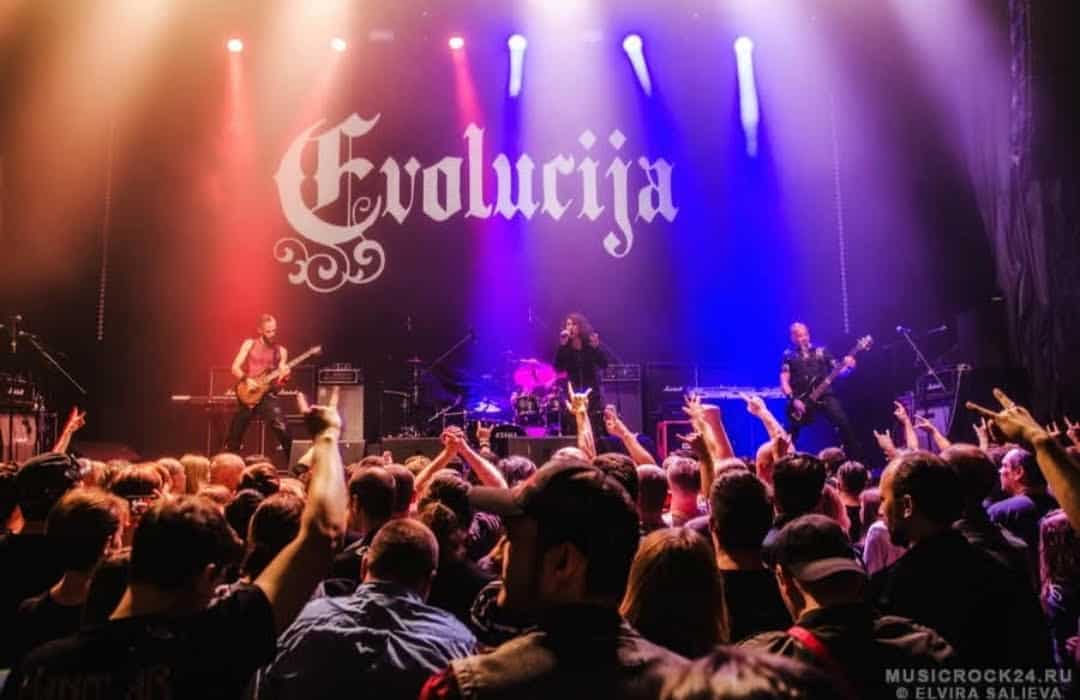
Metalwar: How would you describe the evolution of Evolucija since 2007, especially regarding your sound and identity?
Evolujia: “Since 2007, Evolucija has changed a lot, both musically and personally. In the beginning, we were still searching for our identity and experimenting with different ideas, but over the years our sound became darker, heavier and more atmospheric. I think today we understand much better who we are as a band. We are not trying to follow trends or sound modern just for the sake of it. We prefer honest music with emotion, strong melodies and powerful riffs,
but also with deeper atmosphere and meaning behind it. Another important part of our evolution was life itself. Moving from Switzerland to Serbia, different experiences, concerts, changes in the lineup, even difficult periods like the
pandemic — all of that influenced the music naturally. Today Evolucija sounds more mature, more confident and emotionally stronger than ever before.”
Metalwar: The name Evolucija means “evolution.” How consciously has this idea influenced your music, lyrics, and overall aesthetic as a band?
Evolujia: “The idea of evolution has always been deeply connected to the band, not only through the name, but also through the way we think and create music.
For me, evolution means constant searching, growing and changing without losing your core identity. I think that is exactly what happened with Evolucija over the years. Musically, we never wanted to repeat ourselves. Every album brought something new — sometimes heavier guitars, sometimes more orchestral elements, sometimes darker
emotions or different lyrical themes. But even with all those changes, I believe people can still recognize our atmosphere and emotional identity.
Lyrically, we are interested in human nature, inner struggles, society, hope, fear, faith and the direction in which the world is moving. In a way, the band itself reflects the world around us — constantly changing, sometimes progressing, sometimes falling apart. Even visually, we are attracted to contrasts: beauty and darkness, strength and fragility, modern and timeless elements. All of that became part of Evolucija naturally through the
years.”
Metalwar: You are a band that started with lyrics in Serbian, switched to English, and then returned to your native language. How does this linguistic identity affect your creative process?
Evolujia: “Language changes the emotion of a song more than people sometimes realize. Serbian and English do not sound or feel the same, so naturally they influence the way we write music and express emotions. When we write in English, the songs often become more universal and atmospheric. English works very well with melodic and symphonic metal because of its rhythm and flow. It also allows the music to reach people from different countries more easily.
But when we returned to Serbian, something became more personal and emotionally direct. Some emotions, thoughts and images simply sound stronger in your native language.
Serbian has a certain rawness and depth that can create a very powerful atmosphere. For us, it was never about choosing one language against another. It was more about choosing the language that best fits the emotion and story of a particular song. In the end, honesty is more important than language itself.”
Metalwar: What was the main idea behind Neću da pevam o ljubavi, and what did you want to express through this album?
Evolujia: “‘Neću da pevam o ljubavi’ was a very important album for us because it was the first time we fully expressed ourselves in our native language. That changed the emotional depth of the music a lot.
The album was never meant to be about simple romantic love. The title itself was almost a reaction against superficial emotions and empty clichés that we see everywhere today.
We wanted to talk about deeper human experiences — disappointment, inner struggles, loneliness, social pressure, the loss of real values and the feeling that people are becoming more distant from each other. In many ways, the album reflected how we saw the modern world around us.
Singing in Serbian made everything feel more personal, raw and emotionally honest. Some thoughts and emotions simply sound stronger in your own language.
Musically, we tried to combine heavy riffs and dark atmosphere with strong melodies, because for us sadness and beauty often exist together.”
Metalwar: In the new album, you combine traditional heavy metal with symphonic and orchestral elements. How do you find the balance between power and melody?
Evolujia: “For us, the balance between power and melody comes very naturally because both elements are equally important to the identity of Evolucija.
We grew up listening to traditional heavy metal, so strong riffs, energy and powerful guitars will always be the foundation of our sound. But at the same time, we are also very attracted to atmosphere, emotion and cinematic elements. The orchestral and symphonic parts are not there just to sound ‘epic’. We use them to create
emotion, tension and images inside the listener’s mind. For me personally, music has always been something magical — you hear a song and immediately start creating pictures and emotions in your head.
When we write songs, we try to avoid chaos. Even if the arrangements are rich, every melody and every orchestral layer must serve the song itself. Sometimes silence or a simple melody can be stronger than something overly complicated.
I think the real balance comes from emotion. If the emotion feels honest, then heavy riffs and orchestral melodies can exist together very naturally.”
Metalwar: What were the biggest challenges during the production of the new album, especially regarding the recording process and the mixing/mastering at Fascination Street Studios?
Evolujia: “The biggest challenge during the production of the album was definitely time and the atmosphere in which the album was created. A large part of the process happened during and after the pandemic, and honestly, that period affected us psychologically more than we expected. There was a strange feeling in the world, almost like everything was becoming uncertain and unstable. We had moments where it really felt like the world was moving in a dark direction.
At the same time, we wanted this album to sound bigger, deeper and more mature than anything we had done before. We spent a lot of time working on details, arrangements and atmosphere. Sometimes that process was exhausting, but we did not want to release something unfinished just to be fast.
Working with Fascination Street Studios was a great experience for us. Jens Bogren, Linus Corneliusson and the whole team brought a new level of sound and clarity to the album.
They understood very well the balance between heaviness, melody and atmosphere that we wanted to achieve.
When we finally heard the finished masters, it felt like the album had become exactly what we imagined in our heads for years.”
Metalwar: Your sound often combines epicness, dark atmosphere, and dynamic riffs. Which bands or artists influenced you the most in this direction?
Evolujia: “We were influenced by many different bands and artists through the years, not only from metal but also from film music and classical music.
From the metal world, bands like Iron Maiden, Black Sabbath, Nightwish, Paradise Lost, Type O Negative and Dio definitely left a strong impact on us in different ways. Some influenced the heavy riffs and energy, others the atmosphere, darkness or emotional depth. We were always attracted to music that creates a world around the listener, not just songs built for entertainment.
At the same time, orchestral film music also inspired us a lot because it creates emotions and images without words. We love music that feels cinematic and takes you somewhere mentally.
But honestly, I think influences are only the starting point. Over the years, Evolucija naturally developed its own identity through our personal experiences, emotions and the way we see the world today.”
Metalwar: How important is the visual aspect for you, especially since you released several singles with videos before the album came out?
Evolujia: “The visual aspect is very important for us because music is not only something you hear — it is also something you feel and imagine. Especially with our music, atmosphere plays a huge role, so visuals help us complete that emotional world around the songs.
Before the album was released, we wanted every single and video to create a certain mood and give listeners a small glimpse into the atmosphere of the album itself. Sometimes a single image, color or scene can express emotions that are difficult to explain with words.
We also live in a time where visual communication became very powerful. People often experience music through videos, social media and images first, so we try to make sure that the visual side carries the same emotional identity as the music. At the same time, we never wanted visuals to become more important than the songs themselves. For us, the music always comes first. The visual aspect should support the emotion of the song, not hide the lack of it.”
Metalwar: You already have experience performing in different countries and major festivals. Which live experience has stayed with you the most?
Evolujia: “We have many beautiful memories from concerts and festivals, but one moment that stayed with me forever happened in Iași, Romania.
During our performance, there was an enormous storm and heavy rain. Honestly, we thought people would leave. But instead, the audience stayed with us until the very end, completely soaked by the rain, singing and supporting us with incredible energy. That moment meant a lot to me because it reminded me what live music is really about. It is
not about perfection or comfort — it is about connection between people through emotion and music.
We also had unforgettable experiences sharing stages with bands we grew up listening to, like Doro Pesch or Paradise Lost, but sometimes the strongest memories come from simple human moments like that concert in the rain. Those are the moments that remind you why you continue making music.”
Metalwar: How does performing live for Balkan audiences differ from playing in other European countries?
Evolujia: “Every country has its own atmosphere and mentality, and that is something beautiful about live music. I think Balkan audiences are extremely emotional and passionate. People here react very directly and honestly to music. When they feel something, they really show it, and that creates a very intense connection between the band and the audience.
In some Western European countries, audiences can sometimes be more reserved at first, but they are also very respectful and deeply focused on the music itself. So the energy is different, but still very special in its own way.
What I personally love about Balkan audiences is that they often experience music almost with their whole heart. Maybe because life in this region was never easy, people connect strongly to emotion, melancholy, struggle and passion in music. At the end of the day, good music can connect people everywhere, regardless of language or country. That is probably one of the most beautiful things about metal music.”
Metalwar: The song “Pale Rider” was written for the movie Die Templerherren. What was the experience of composing music for film like?
Evolujia: “Working on ‘Pale Rider’ for the movie ‘Die Templerherren’ was a very special experience for us because it was something completely new at that time. We originally sent a demo version of the song to the audition, and from many submitted songs they selected ours.
After that, we were contacted by the production team and started adapting the song more closely to the atmosphere and story of the film.
What made the experience interesting was learning how differently music functions in film compared to a normal album song. In film, the music becomes part of a bigger emotional picture. It has to support scenes, tension and storytelling in a different way. We also filmed the video near Munich in a beautiful castle, and we were invited to the movie
premiere. For us, that whole experience felt almost surreal because at that time we were still a young band.
I think ‘Pale Rider’ was an important moment for Evolucija because it opened our minds even more toward cinematic atmosphere and storytelling through music.”
Metalwar: Hunt received significant recognition and was awarded album of the year. How did that affect your confidence and expectations as a band?
Evolujia: “When ‘Hunt’ received the award for album of the year, of course it meant a lot to us. As musicians, you spend years working, doubting yourself, sacrificing time and energy, often without knowing how people truly see your music. So when an album receives that kind of recognition, it gives you confirmation that your work reached people emotionally.
At the same time, we tried not to let it turn into pressure or ego. Awards are beautiful, but they cannot become the main reason for creating music. The most important thing for us is still honesty and emotion inside the songs.
I think the biggest thing that changed was our confidence. We became more sure of our identity and more courageous to follow our own direction instead of trying to fit into expectations or trends.
In some way, ‘Hunt’ gave us the feeling that Evolucija had truly found its own voice.”
Metalwar: What do you consider to be the most recognizable element of Evolucija today: the vocals, the guitar themes, the atmosphere, or the thematic message?
Evolujia: “I think the most recognizable element of Evolucija is probably the atmosphere, because all the other elements become part of it. The vocals, the guitar melodies, the orchestral layers and the lyrical themes all work together to create a certain emotional world around the music.
We never wanted to create songs that are only technically heavy or only melodic. What matters most to us is the feeling that remains after the song ends. Sometimes it is melancholy, sometimes tension, sadness, strength or reflection about the world and human nature.
I also think people recognize the contrast inside our music — beauty and darkness existing together. Heavy riffs and aggression on one side, but emotion, vulnerability and atmosphere on the other.
For me personally, music becomes powerful when it creates images and emotions in your mind, almost like entering another world for a few minutes. I think that cinematic and emotional atmosphere is probably the strongest identity of Evolucija today.”
Metalwar: What do you want listeners to feel when they hear an Evolucija song from beginning to end?
Evolujia: “I would like listeners to feel that they experienced a real emotional journey, not just listened to a song. For me, music is something almost magical. You hear certain melodies or atmospheres, and suddenly your mind starts creating images, memories and emotions that are difficult to explain with words.
With Evolucija, we want people to feel emotion, reflection and connection. Sometimes sadness, sometimes strength, sometimes hope — but always something honest. Even when our music is dark or heavy, we are not trying to glorify negativity or hopelessness. There should always remain some human feeling inside it.
A lot of modern music today feels very fast and disposable. We try to create songs that stay in the listener’s mind a little longer and maybe even make people think about themselves, about the world or about the direction humanity is moving in. If somebody finishes one of our songs and feels emotionally touched or mentally transported somewhere else for a few minutes, then we achieved something meaningful.”
Metalwar: What are the next steps for the band? Are there plans for new videos, a tour, or new material?
Evolujia: “Yes, we already have plans for the future and we are very motivated to continue moving forward. At the moment, we are focused on promoting ‘The World Is Full of Wrath’ through live performances, interviews and videos. We are also discussing new concert dates and possible tours in different countries because live music is extremely important to us.
We definitely plan to release more videos in the future. Visual atmosphere is a big part of Evolucija, so we always enjoy creating something that gives another dimension to the songs.
At the same time, we already started working on new material and slowly developing ideas for the next album. Even while finishing one album, new riffs, melodies and lyrical concepts begin to appear naturally. I think that is simply part of being a musician — you never completely stop creating.
Our goal is to keep evolving, stay honest to ourselves and continue building a deeper connection with people through music.”
Metalwar: Do you think gothic/symphonic/heavy metal still has room today for new storytelling, or has it become a more “closed” genre?
Evolujia: “I definitely think there is still room for new storytelling in gothic, symphonic and heavy metal. Maybe the genre is not as dominant in mainstream media as it once was, but emotionally and artistically it still has enormous potential.
What sometimes makes a genre feel ‘closed’ is when bands start repeating the same formulas, aesthetics and themes without real emotion behind them. But as long as musicians have something honest to say about life, humanity, fear, hope or the world around us, there will always be space for new stories.
I think people today are actually searching more and more for deeper atmosphere and meaning in music because modern life became very fast, superficial and materialistic. Many listeners want to feel something real again.
For me personally, metal was never only about aggression or darkness. It can also carry beauty, spirituality, sadness, reflection and even hope. That combination still has a lot to say in today’s world.”
Metalwar: How do you write lyrics: do you start from personal emotions, social themes, or from a more narrative idea?
Evolujia: “Usually, our lyrics begin from emotions and thoughts that we genuinely feel inside, but those emotions often become connected with larger social or human themes. Sometimes a song starts from something very personal — fear, disappointment, sadness, hope or inner conflict — and then grows into a wider reflection about society or the direction in which the world is moving.
Other times, a strong image or atmosphere appears first, almost like scenes from a movie inside the mind, and from there the story slowly develops. We are very inspired by atmosphere and emotion, not only by literal storytelling.
I think what connects all our lyrics is honesty. We do not want to write empty words only because they sound dark or dramatic. Even when the themes are heavy, there should still be something human and real behind them.
Many of our songs are also influenced by the feeling that modern society is becoming more distant, materialistic and spiritually empty. People are connected digitally more than ever, but emotionally they often feel more alone. Those thoughts naturally enter our music.”
Metalwar: Is there a song of yours that you feel captures the true essence of Evolucija best?
Evolujia: “I think that is a very difficult question because every album represents a different period of our lives and emotions. But personally, one song that feels very close to the true essence of Evolucija for me is probably ‘Seven Days’.
That song contains many things that define our music today — heaviness, atmosphere, melody, emotional storytelling and reflection about humanity itself. It speaks about the absurdity of war, human suffering and the emotional scars that people carry long after wars officially end.
What is important to me in that song is that it does not glorify darkness or violence. At the center of it is a human being — broken, traumatized and emotionally destroyed by what he experienced. I think that human dimension is very important in our music. Even when Evolucija sounds dark or heavy, there is always sadness, empathy and reflection
behind it. We are more interested in what happens to the human soul than in aggression itself.
I think ‘Seven Days’ captures very well the emotional and cinematic identity of the band.”
Metalwar: How has the way you compose music changed from your early years until today?
Evolujia: “In the early years, composing music was more instinctive and spontaneous. We were driven mainly by energy, passion and the excitement of creating something heavy and emotional. At that time, we experimented a lot and searched for our musical identity without overthinking too much.
Today the process became deeper and more atmospheric. We pay much more attention to emotion, dynamics, arrangements and the overall feeling that a song leaves behind.
Sometimes a song can begin from a simple riff, but other times it starts from an atmosphere, an emotion or even a mental image that slowly grows into music.
I think life experience also changed the way we compose. After everything we lived through — concerts, personal struggles, the pandemic, the situation in the world — the music naturally became more mature, darker and emotionally layered. At the same time, we learned that not everything needs to be technically complicated. Sometimes simplicity, silence or one honest melody can say much more than hundreds of notes.
Today we compose less with the idea of impressing people and more with the desire to create something emotionally real and lasting.”
Metalwar: If you had to describe the band’s music to a new listener in just one sentence, what would it be?
Evolujia: “Evolucija is a blend of heavy riffs, cinematic atmosphere and emotional storytelling that reflects both the darkness and the humanity of the world we live in.”
Interview – text: Spyros Tribos

No comments yet. Be the first to comment!