
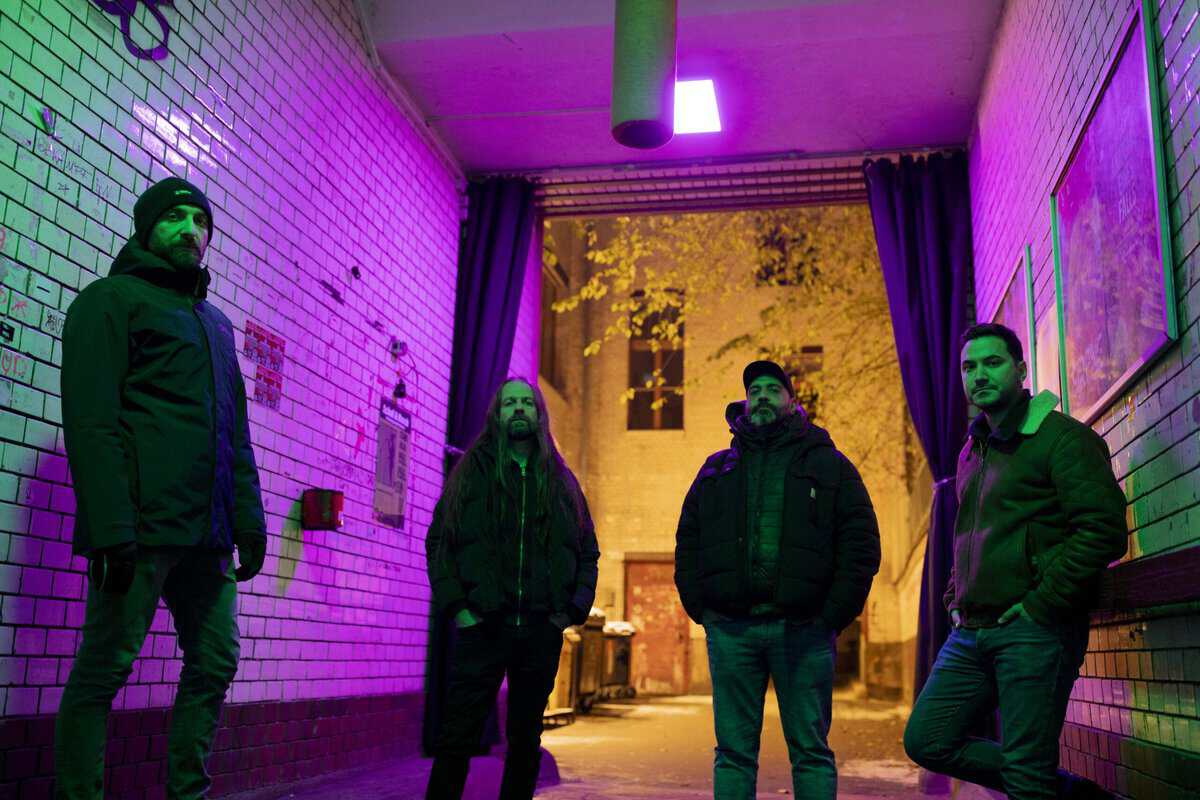
Metalwar: NATURA feels like a conceptual journey—was the narrative planned from the beginning, or did it evolve naturally during the writing process?
Hasan: It is intertwined. Some songs, such as Gaia, were written in early 2019, long before I had the concept of Natura. During the writing process back then, the underlying feelings were unarticulated, but still related to the concepts such as will to power, the stain we leave on earth as species, loss, and inequality. For some songs, like Parrhesiastes, they more or less emerged together with the story.
Metalwar: Your sound blends post-rock, post-metal, and progressive elements. How do you maintain balance between atmosphere and heaviness?
Hasan: We like thinking about the dynamics within and between the songs, using different effects, sounds and time signatures. All band members have been exposed to heavy music in one way or another, so heaviness is built-in.
Metalwar: The album deals with themes like grief, alienation, and the Anthropocene. How important is it for you to address real-world issues in your music?
Hasan: To me personally, it is therapeutical. Looking at the conjuncture we live in, I sometimes feel weak, thinking that we will not be able to change the world for better. Being the guests, and not conquerors of this planet, I feel the pain of failing the duty of leaving a nicer world behind for the generations to come. When playing these songs, thinking about them, writing them, I feel I am part of something ancient and shared. Part of the collective wisdom of all who came before. I feel I am becoming one with many I do not know personally. It is like having a shimmer of light in a deep, dark and endless well.
Metalwar: Can you tell us more about the idea of the “solitary seeker” that appears throughout NATURA?
Hasan: Some of us, overwhelmed by everything unfolding in the world, find ourselves searching for an answer to one persistent question: “After tens of thousands of years of human growth and progress, why do we still find ourselves living through such devastating events? How did we come to this point?” The Solitary Seeker is a symbolic figure, a soul who carries these very questions. S/he turns to Natura, a book of wisdom, hoping to find the answers, and ultimately, to decide what kind of person s/he must become in order to face this world.
Metalwar: Musically, do you approach songwriting more from a riff-driven perspective or through mood and texture?
Hasan: Mostly, songwriting begin with a riff, a sound that feels right and becomes the core of everything that follows. From it, other melodies grow, each with their own character, forming kinships until together they become a song contained within a story.
Metalwar: The concept of “parrhesiastes”—the truth-teller—is central to the album. How does that idea resonate with you as artists today?
Hasan: Well not only as an artist, but as a human, being a parrhesiastes is the most honest way to face anything that challenges or unsettles us. Personally, it is my identity. And for me, existence is resistance.
Metalwar: How has being based in Berlin influenced your sound and artistic identity?
Hasan: Most of the band members, if not all, have immigrant backgrounds, and Berlin is one of Europe’s most diverse cities. That intersection, being outsiders who found a home here, might be feeding directly into our thematic focus on displacement and belonging. Take Behind the Resilience, the refugee album as an example. The story was not an abstract political statement, it came from living in a city where those stories are all around you. Berlin is where a lot of people arrive.
Metalwar: Compared to your previous releases, what makes NATURA a step forward for KATRE?
Hasan: For me, Natura continues the story-driven, narrative-based approach of our first two studio albums, and that consistency is something I see as a step forward. But the real progress is something else: the idea that began as a studio project has grown into something much more alive over time. As mentioned, all members are now based in Berlin, which means we rehearse together, play live together, and truly inhabit the songs together. That shift has changed everything – how we approach the music, how we talk about it, how we record it. The songs now carry the energy of a band that shares the same room, the same city, the same moment.
Metalwar: The single “Gaia” carries strong emotional and environmental weight. What was the inspiration behind it?
Hasan: Ercan Kesal is an exceptional author (he actually has many hats as screenwriter, physician, actor, director…). Back in the day, one phrase I saw in one of his interviews inspired the whole story behind our first studio album “Encounters”. This phrase was “the unrelated details give our lives a meaning”, if I may roughly translate it from its original version in Turkish. Coincidentally enough, in one of his books, I read this expression: “only humans persist in this stubborn struggle against nature – a struggle we seem fated, in the end, to lose“. This got me thinking: If we are doing this to our “mother nature” (Gaia), how should she respond to us? This was the inspiration behind the song Gaia.
Metalwar: How do you translate such a layered and conceptual album into a live performance?
Hasan: Backtracking is quite important for us when playing live. Although we try to keep as much busy as we can on the stage with our instruments, we do rely on some FXs to best reflect our layered sound. As for bringing the concepts to life on stage, that is always a challenge. It would be wonderful to one day play the albums from start to finish, with films related to the concepts playing behind us. That would be something special.
Metalwar: What do you hope listeners take away from NATURA after experiencing it from start to finish?
Hasan: Their own answer to the question of “how did it come to this?”, whatever their own context may be.
https://www.youtube.com/thekatre
https://www.instagram.com/katremusic
KATRE – GAIA
No comments yet. Be the first to comment!