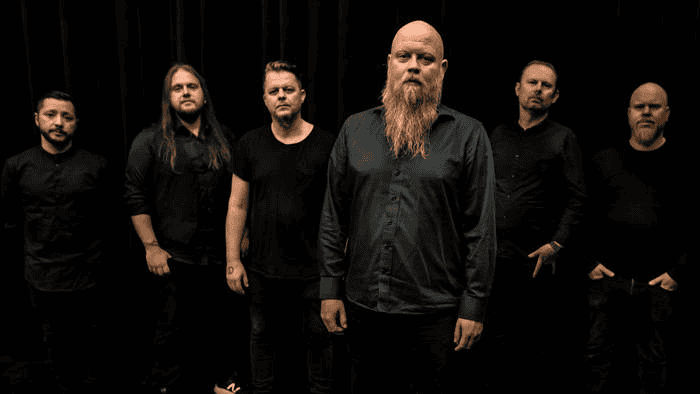
Emerging from the misty landscapes of Kristiansand, Norway, Green Carnation have carved one of the most fascinating journeys in the progressive metal world.
Founded by Tchort (Terje Vik Schei) in the early ’90s, the band’s evolution from dark doom origins to intricate, melancholic, and atmospheric soundscapes has made them a cult favorite among fans of emotional and intelligent metal. With monumental works like Light of Day, Day of Darkness and their new conceptual trilogy A Dark Poem, Green Carnation continues to prove that true art knows no boundaries — only transformation.
Jo: Let’s start with something fun — could each of you introduce yourselves, tell us your role in Green Carnation, and maybe share a quirky or unexpected thing about yourselves that fans might not know?
Kjetil: Hey Jo. I will be the one answering the questions, and I am Kjetil Nordhus, the singer of Green Carnation, and I am also the co-writer of the songs on our trilogy A Dark Poem, Part I, II and III. Quirky or unexpected fact? When asked about that, I normally say that I was once in a long interview with Playboy Mexico.
Jo: A Dark Poem, Part I: The Shores of Melancholia is the start of a trilogy. Can you tell us what the overarching concept or vision is for the trilogy, and how Part I fits into it?
Kjetil: It has been an ambition in Green Carnation for many, many years to do a really epic long story telling concept, and we felt the time was right for us to try to do it. This was back in 2018, and we used a loooong time on getting it all finished. I don’t think we knew the actual amount of work it would take for everything to be at the level we needed it to be, but here we are, having recorded it all, and able to show the first of the three albums to the rest of the world. We needed the first part to gather people’s attention, and have put together an album in order to manage that. The next one will be quite different, and then the third will surprise everyone, we think. So – still a lot to wait for.
Jo: How does the lyrical content reflect your current views or feelings about the world? Does The Shores of Melancholia address contemporary issues or more personal/emotional themes?
Kjetil: Both, actually. I think you will hear that when listening to the album. And sometimes the personal/emotional themes and the feelings about the world will be two sides of the same thing. I think it is right to say that The Shores of Melancholia is about losing control, both when it comes to personal issues and the more universal ones, and the uncomfort we have dealing with this. These are themes that go through the entire trilogy.
Jo: Your music has shifted a lot over the years — from heavy doom to acoustic and prog. How do you decide which direction to explore next, and does anyone ever surprise the others with a crazy idea?
Kjetil: Hehe, yes, we surprise each other all the time, and I do think our fans kind of expect us to surprise them too. When doing this extremely ambitious trilogy project I think we will surprise both ourselves and our fans in ways we have never done before.
Jo: After a long gap between Acoustic Verses (2006) and Leaves of Yesteryear (2020), what motivated the band to return to recording? What changed in the band or environment?
Kjetil: We finished as a band in 2006 and had no plans to return before the Light of Day, Day of Darkness came along in 2016. We did a few big comeback shows in Europe and North America and after that we decided that we wanted to continue making music, and signed a five album deal with Season of Mist. And here we are.
Jo: Light of Day, Day of Darkness is one track of about 60 minutes — what inspired you to make such an ambitious, singular piece? How did you approach the songwriting and production for it?
Kjetil: That was such a long time ago, and I think it is right to say that Light of Day, Day of Darkness found its form during the composing and the studio process. It was never something we thought about up front, that «now we are going to make a 60 minute song», but when putting all the ideas together, it was quite clear for us that this had to be the way for people to listen to it.
Jo: Over the years your style has shifted a lot (from death metal to doom- progressive, to acoustic, etc.). How do you decide which direction to explore for each album?
Kjetil: It is always the direction that feels natural for us. We will always be motivated by discovering new sounds and new ways of storytelling, and when having an idea of what we want to do, we just have to stay true to the idea and motivation and dare to follow it 100 percent, to see how well we can fulfill our ambition.
Jo: The production seems very atmospheric and layered. What is your process in the studio for achieving the desired sound? Any favorite techniques or challenges you encountered recently?
Kjetil: We chose to go to dUb Studios again, because we knew what we would get from the studio and of course from Endre Kirkesola who is the engineer and producer there. He would always understand what we need, and has the quality to bring out the best of us all. Endre is a part of the Green Carnation family and he is now indeed also our new keyboardist. So I guess it is right to say that this was a good marriage.
Jo: How do you balance heaviness and melody, aggression and atmosphere, in your music?
Kjetil: That is impossible to explain. It is just the way we make music. I think Stein Roger and myself found a great way of working together, with him being the guy able to play all instruments when composing new music, and with myself being more of a guy aware of the actual compositions and the big and small details from the first to the last second.
Jo: Which album or song do you believe has been the most pivotal in defining your identity as a band, and why?
Kjetil: I think Light of Day, Day of Darkness did a lot for the band. It was our breakthrough album internationally and we would never have been where we are today without that album.
Jo: How important is the live performance for you? For example, performing Light of Day, Day of Darkness in its entirety — what did that feel like, and how do you adapt That kind of music for live settings?
Kjetil: It is extremely important for us, and we are putting in one hell of a job in being able to present our music live in the very best way. It is a lot of work, and it took me until I was 45 years old to understand how big a difference 90 and 100 percent is. I think the last 10 percent are much more work than the first 90 percent. When rehearsing Light of Day, Day of Darkness to our 2016 comeback that became very clear for me.
Jo: What role does artwork, visuals, and music videos play in how you present an album or song? Can you share how the art for The Shores of Melancholia was created (artist, idea, symbolism)?
Kjetil: Yes, we are lucky to have the artist Niklas Sundin aboard. Niklas has been in the Green Carnation family since Light of Day, Day of Darkness (he made that cover, back in 2001), and have worked with him in several projects after that. Niklas understands us, and we trust him. So we explained to Niklas the basics about what we wanted to do, and shared all the demos and lyrics, and he came back with the drafts of what became the visual concept of A Dark Poem.
It suited us perfectly, not surprisingly.
Jo: Looking ahead: what are your goals for the future (Part II & III of the trilogy, possible experimentation, touring, new collaborations)?
Kjetil: We have at least two more years in A Dark Poem now, and we would like to be able to present our music live, to as many people as possible, on festivals and short tours. After that we have no idea yet, but there is many experiences to be had before we have to think about that.
Jo: Thank you so much to Green Carnation for taking the time to share their thoughts and stories with us. Your music continues to inspire with its depth, emotion, and evolution. We wish you endless creativity and look forward to the next chapters of A Dark Poem.
Kjetil: Thank you Jo. I have enjoyed answering your questions. And, if your Playboy shock is over now, I can say that it was a music interview. Much like this.
Greetings,
Metalwar.gr
Interview – text:
Joanna Gonas