
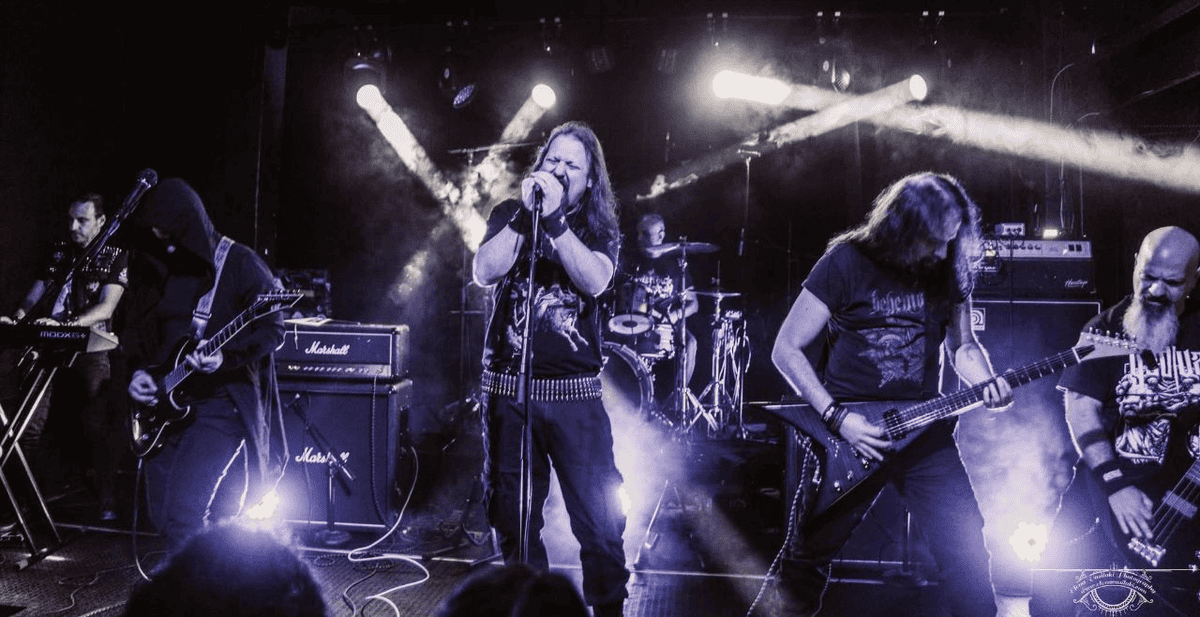
Where the blackness of space meets the epic symphonies of the abyss, Sinistrous Mist rise in majesty.
With their debut album “A Voice Through Constellations” resonating like a triumphant return to the golden era of Majestic Black Metal, the Athens-based band invites us on a journey beyond earthly limits. Today, at Sound Stories by Jo and Metal War, we speak with the architects of this cosmic darkness about their symphonic influences, their Temple experience, and the vision behind the mist.
Jo: Panos, the project began in 2022 as your personal vision. What was the “calling” that made you feel the Greek scene needed the return of that Majestic/Symphonic sound that flourished in the late ’90s?
Panos: First of all, thank you very much for the interview and for presenting our band and our debut album.
Regarding the Majestic sound of the band, that was indeed the primary goal, and I am very happy we achieved it. My influences are varied. I’m fortunate enough to have experienced this sound from its very beginning in the 1990s. I’m 47 years old and have been listening to metal since the days of Ram It Down and No Prayer for the Dying, when I started buying cassette tapes!
So when bands like Bal-Sagoth, Limbonic Art, Dimmu Borgir, and Cradle of Filth introduced this different style of Black Metal, I was absolutely fascinated. The entire metal audience was fascinated.
At the same time, I was also listening to—and still listen to—melodic Heavy Metal like Pretty Maids, Praying Mantis, Crazy Lixx, Def Leppard, and of course the classics Judas Priest and Iron Maiden, among many others.
So musically I exist at two extremes, which naturally led me to compose Black Metal that is also highly melodic—and that eventually evolved into what became our Majestic sound.
Jo: Your debut album was released in February 2026. Who—or what—is this “voice through the constellations”? Is it a cry of despair toward the universe, or a message of dominion?
Giorgos: A Voice Through Constellations is neither a cry nor a declaration of power. It is more of a summoning—something that begins with us, but does not end with us.
There is this feeling of reaching out toward something you cannot define. Something that may already be there, beyond the concepts we use to describe it.
We try to give it form, to name it, but every such attempt is merely a reflection of our own understanding. Even the entire tradition surrounding the occult—texts, symbols, rituals—feels more like traces than answers.
As if you are looking at something through layers of translation, never truly reaching its core.
So this “voice” is not necessarily something that speaks clearly. It exists at the edge of perception—and all you can do is turn toward it and listen, without ever being certain what exactly you are hearing.
And perhaps that is the most honest point of all:
We do not know what is out there.
But we continue to call… and to listen.
Jo: Your sound radiates a strong nostalgia for the golden era of Limbonic Art and early Dimmu Borgir. How do you keep that Majestic character alive in 2026 without sounding like a mere reproduction of the past?
Panos: The goal of every musician who respects himself is not to copy.
The inspiration from those bands certainly exists, but my influences are broad. I also draw inspiration from anime with exceptional soundtracks, as well as a great deal of classical music.
These are the foundations of my influences, and that is why our sound does not feel identical to the past.
I strive to create new melodies rather than rely on safe formulas.
Also, I am not particularly a fan of early raw Black Metal production. I prefer a modern sonic texture.
In short: our guitars and drums have a Heavy Metal tonal character, but with Black Metal playing styles.
Jo: In Majestic Black Metal, keyboards often take center stage. How do you build such massive layers of sound without sacrificing the aggression Black Metal demands?
Panos: It is difficult, honestly.
Every musician wants everything to be clear and audible, but that is never easy. This is where the engineer becomes crucial, offering the right advice.
Of course, experience helps—it’s not the first album I’ve recorded—but the puzzle is always complex.
It takes many hours of patience, persistence, and logical thinking to achieve the desired result.
And I will say this: mathematics are not far removed from having ten keyboard tracks and making them sound balanced enough for the listener to clearly hear the foundation—which is the guitars—because the common denominator remains Metal, and we never want to lose that.
Jo: Lefteris, in such a dense sonic environment filled with keyboards and guitars, what role does the bass play? Is it the glue that keeps the band grounded, or does it contribute to the otherworldly atmosphere as well?
Lefteris: The bass is, by nature, an underrated instrument.
Its job is almost never to be the protagonist. Its primary role—alongside the drums—is to build the foundation upon which the other instruments paint. Including the vocals, which I also consider an instrument.
In our band, I like to believe my bass is the glue that fills the gaps and ensures the five people recording—or the six playing live—sound like one entity rather than separate individuals playing simultaneously.
That is a huge difference.
As for atmosphere, the keyboards enrich our sonic frequencies so much that there is no need for additional experimentation.
The distance between enrichment and overload is razor-thin.
Jo: Dimitris, on drums you are tasked with balancing blast beats and atmospheric passages. How challenging is it to maintain groove on an album so rich in orchestration?
Dimitris: In our style of music, transitions between blast beats and atmospheric sections are very frequent, so groove remains intact and prevents monotony.
As for our songs, fortunately they feature arrangements full of changes, so I’m very happy with that.
Jo: Giorgos, your addition to the band in 2023 was considered the “final piece of the puzzle.” How did you approach your performance on A Voice Through Constellations to balance raw aggression with the majestic nature of Panos’ keyboards?
Giorgos: In this music, I felt the voice should not lead—it should dissolve.
It should become part of the cosmic current already present.
The keyboards build something enormous, almost unreachable… like gazing upon something you cannot touch.
In that environment, pure aggression alone is not enough—you must leave space for the universe of the song to breathe.
So I worked a lot with distance.
Sometimes the voice comes forward like a rupture, and sometimes it retreats, dissolving into the sound.
The aggression here is more erosion than explosion.
It is not immediate—it slowly consumes you, pulling you deeper as the song progresses.
The majestic character is that sense of vastness that makes you feel small within it.
Technically, I worked heavily with texture rather than just intensity.
I allowed the voice to break, to become more ethereal in places—almost like a memory or an echo.
I did not want it to sound entirely human, but like something already existing within the space of the song.
My goal was not to stand apart from the music, but to disappear within it.
Jo: The album artwork is the listener’s first contact with your world. What is the central concept behind it?
Lefteris: The truth is the cover was chosen before the album title was decided.
So it does not directly reflect the lyrics of the title track or its cosmic themes.
What it does visualize is the need to search—not for the voice itself, but for the source of that voice we all hear at some point in life.
I refer to that voice which compels us to question truths long carved into our minds.
It is not about good and evil—those are subjective concepts anyway—but about the need to study “something else.”
Something different from our rooted beliefs.
The figure on the cover heard the voice, followed it, and through hardship and effort, reached his destination.
Jo: If Sinistrous Mist had to visually represent their music in a video clip, what aesthetic would you choose?
Lefteris: Both directions are equally tempting.
The fantasy-loving side of me screams for magical worlds—cosmic, astral, subterranean, crushing, surreal and grim.
But the rotten metal side of me says “no.”
Darkness and atmosphere in black and white.
That is what I would choose.
The music is rich enough already. I do not ultimately feel the need for extravagant visual representation.
Jo: How difficult was it to communicate your musical ideas in the studio?
Panos: All the songs challenged us—but it was worth it.
As you said, the two elements that clash the most are bass and orchestration.
To preserve the “Majestic” element of the album and our signature tone, the bass had to sit slightly lower than the other instruments.
Still, I believe in most parts of the album the bass remains clearly audible—either when playing different melodic lines from the guitars or when playing entirely alone.
There is even a section in the album where only the bass plays!
Quite rare for a Black Metal band.
Jo: How much time did you spend balancing the frequencies in the mix?
Panos: When instruments do not occupy the same scales, the result becomes cleaner.
A puzzle indeed—but we knew the solution from the beginning.
It probably helps that I am not self-taught and have studied Harmony and Counterpoint, so I adapted everything accordingly on the staff with the proper scales.
That was perhaps the only easy puzzle because I had the musical knowledge.
Jo: After your Temple performance, how does the Majestic studio atmosphere translate to a live venue?
Lefteris: It is the excitement and the voice of the crowd that energize the band on stage.
Combined with our own anticipation, the songs likely become a bit rougher—and perhaps slightly faster—which is not necessarily a bad thing.
No one wants to hear the crystal-clear CD sound in a live performance.
Our layered sound naturally becomes more condensed, but we strive to deliver the compositions faithfully while covering them in the essential veil of raw power that defines live music.
Jo (+1): If A Voice Through Constellations were a signal traveling through the void of space, who would you want its final recipient to be?
Lefteris: Our music has no intended final recipient.
It has an intended reaction.
Whoever hears it—we want them to enjoy it.
So much that they feel the need to hear it again.
That is what we want as a band and as people.
That is the reason this CD exists.
We want people to listen to Sinistrous Mist and feel their soul uplifted.
And from our side, a kind word is the greatest reward we can receive.
Jo: You recently performed at Storming the Gates Festival in Athens. How did the crowd’s response affect the band’s psychology moving forward?
Panos: Storming the Gates was our second live performance, and I can honestly say the audience felt different.
In a positive way, certainly.
Our album is now being heard—whether through CD sales or through YouTube uploads on various channels.
So we had active crowd participation, and that made us extremely happy.
People are beginning to know the songs now that A Voice Through Constellations has been out since February 14.
Sinistrous Mist have proven to us that melody can be just as terrifying and imposing as raw violence.
We thank them for this atmospheric conversation and for the voice they gifted us through their constellations.
Interview- text: Joanna Gonas


No comments yet. Be the first to comment!